Most people assume that once a dental implant is placed, it is permanent. And most of the time, that is true – implants last 20, 30, even 40 years with proper care. But implants are not indestructible. Components crack. Crowns chip. Abutments loosen. And in rare cases, the implant post itself fractures. When that happens, patients often have no idea where to turn, because most dental offices are not set up to repair broken dental implants – they are set up to place new ones.
If you have a failing, damaged, or broken dental implant, you have more options than you may think. This guide explains exactly what breaks, why it breaks, and how a specialist can repair or restore your implant without always starting from zero.
This article is for educational purposes only and does not constitute medical advice. Please consult a qualified implant specialist to evaluate your specific situation.
Not All Broken Dental Implants Are the Same Problem
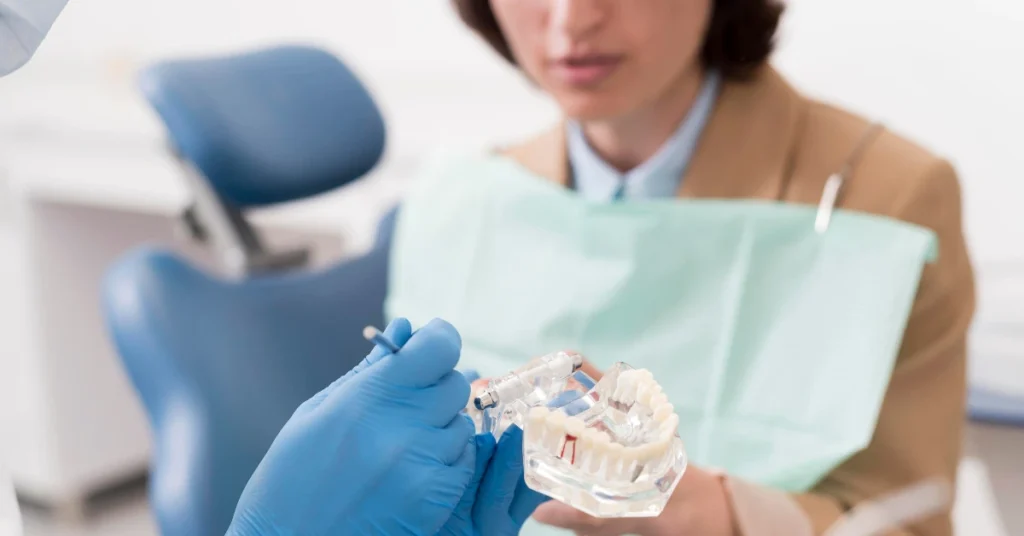
The term “broken dental implant” covers several very different situations, and the right repair depends entirely on which component is involved. An implant system has three parts: the titanium post anchored in the jawbone, the abutment that connects the post to the visible restoration, and the crown itself. A problem with any one of these looks and feels different – and has a different solution.
Here is how each type of failure presents:
- Crown fracture or chipping – The most common situation. The porcelain or ceramic crown cracks, chips, or breaks off completely. The implant post and abutment below are often still perfectly intact. This is the easiest situation to repair – usually a crown replacement without touching the implant itself.
- Abutment loosening or fracture – The connecting piece between the post and crown either works loose over time or snaps under biting load. You may notice the crown feels slightly mobile or the angle seems off. A loose abutment can often be re-torqued or replaced. A fractured abutment requires removal and replacement.
- Implant post fracture – The titanium post itself breaks, usually at the thinnest point near the bone crest. This is the most serious scenario and the least common, affecting roughly 0.1-0.5% of placed implants over 10 years (pubmed.ncbi.nlm.nih.gov). It typically requires surgical removal of the fractured segment, bone grafting, and re-implantation.
- Implant failure from bone loss – Not a mechanical break but a biological one. The implant post remains structurally intact but loses its integration with surrounding bone due to peri-implantitis, trauma, or systemic factors. The implant becomes mobile and must be removed.
Diagnosing which situation you are dealing with requires a clinical exam and, in most cases, a 3D cone beam CT scan. X-rays alone often miss the detail needed to plan a repair broken dental implant case accurately.
Why Dental Implants Break or Fail
Understanding the cause of a broken dental implant matters because the same repair will fail again if the underlying problem is not addressed. Most implant damage falls into one of four categories.
Mechanical overload is the leading cause of crown and abutment fractures. Biting forces in the molar region average 170-200 pounds of force per square inch (ncbi.nlm.nih.gov). Patients who grind or clench (bruxism) direct amplified, repetitive force onto implant components that were designed for normal loading. Without a night guard or occlusal adjustment, crowns and abutments are particularly vulnerable – because implants lack the natural shock-absorbing periodontal ligament that real teeth have.
Peri-implantitis is the biological equivalent of gum disease around an implant. Bacteria colonize the tissue around the implant, triggering inflammation that gradually destroys supporting bone. A review published in the Journal of Clinical Periodontology found peri-implantitis affects approximately 22% of implant patients over time. As bone recedes, the implant loses structural support. What starts as a gum problem becomes an implant failure.
Failed osseointegration occurs when the implant post never fully bonds to surrounding bone after placement. This can result from insufficient primary stability at surgery, premature loading before integration is complete, infection during the healing window, or systemic factors like uncontrolled diabetes or heavy smoking. An implant that never fully integrated is not mechanically broken – but it will behave like one, becoming mobile and eventually requiring removal.
Poor implant positioning creates off-axis biting forces that accelerate wear on the crown and abutment over years. Implants placed at poor angles, too close to adjacent teeth, or too shallow in the bone face higher long-term complication rates. Repairing a broken dental implant in these cases sometimes means relocating the implant in addition to replacing the failed components.
Warning Signs Your Implant Needs Attention Now
A broken dental implant rarely fails without warning. Recognizing the early signals can mean the difference between a simple crown replacement and a full surgical revision. Do not wait to see a specialist if you notice any of the following:
- Crown feels loose or wobbly – Any movement in the visible tooth is abnormal. It usually means the abutment screw has loosened or fractured, and the longer it is left, the more stress transfers to the implant post below.
- Clicking or shifting sensation when biting – A crown that shifts under pressure suggests a loose or fractured abutment. Continuing to chew on it accelerates damage.
- Persistent pain or pressure at the implant site – Implants themselves are not innervated and should not hurt. Pain signals that the surrounding tissue or bone is involved, either through infection, bone loss, or a micro-fracture creating movement under load.
- Gum swelling, redness, or discharge near the implant – Classic signs of peri-implantitis. Early-stage peri-implantitis is treatable and does not always require implant removal, but it will progress to implant loss if ignored.
- Visible changes in gum level around the implant – Recession that exposes the metal collar of the implant indicates bone loss underneath. The structure you can see reflects what is happening below the surface.
- Implant that was never quite right – Some patients describe an implant that always felt off – a bite that never settled, chronic low-grade discomfort, or recurring abutment screw loosening every few months. These are signs of a positioning or stability issue that compounds over time.
If any of these describe your situation, a prompt evaluation is worth more than waiting to see whether it resolves. In implant dentistry, time rarely improves things that have already started going wrong.
How Specialists Repair Broken Dental Implants
The repair process for a broken dental implant depends directly on what failed and why. There is no universal fix – but there is almost always a path forward, even in cases that seem severe.
| What Failed | Typical Repair Approach | Complexity |
|---|---|---|
| Crown chipped or cracked | New crown fabricated, abutment retained | Low |
| Abutment loose | Re-torque or replace abutment screw | Low |
| Abutment fractured | Remove fractured piece, place new abutment and crown | Moderate |
| Peri-implantitis (early) | Debridement, surface decontamination, bone regeneration | Moderate |
| Implant post fractured | Surgical removal, bone graft, new implant | High |
| Failed osseointegration | Remove implant, graft if needed, re-implant after healing | High |
For crown and abutment repairs, the process is relatively straightforward. The restoration is removed (or the crown is detached from the abutment), the damaged component is replaced, and the implant is restored. Most patients are back to normal function within a few weeks.
For cases involving implant removal and replacement, the process mirrors the original implant journey. The failed post is extracted – often using specialized explantation instruments that preserve as much surrounding bone as possible. If bone volume has been compromised by peri-implantitis or by the removal itself, bone grafting is performed to rebuild the site before a new implant is placed. The healing and integration timeline for a replacement implant is similar to the original: 3-6 months before the final restoration is attached.
It is worth noting that replacement implants have strong success rates. First-attempt reimplantation achieves survival rates of 69-96% in the literature, with most studies reporting averages around 86%. Identifying and correcting the reason for the original failure – positioning, occlusal overload, infection – is what protects the replacement long-term.
Why Most Dentists Cannot Help – and Where to Go
Here is something most patients learn too late: the dentist who placed your original implant may not be the right person to repair it, and most general dentists are not equipped to handle complex broken dental implant cases at all.
Repairing a fractured abutment or extracting a fractured post requires surgical skill and specialized instruments. Treating peri-implantitis that has progressed to significant bone loss requires both periodontal expertise and the ability to graft and re-implant in the same clinical environment. And if the original implant was placed by a dentist in another city, another state, or a large corporate chain, the records may be incomplete and the implant system may be unfamiliar.
An implant-only specialty practice evaluates these cases every week. The diagnostic process is different, the surgical options are broader, and the decision about whether to repair or replace is made based on clinical evidence rather than whatever procedure is easiest to bill. Our dental implants page outlines the full scope of implant services available at both locations.
For patients who are anxious about returning to a dental chair after a failed implant experience, IV sedation is available for repair procedures. Most complex repair cases are performed with sedation as standard practice.
Repair or Replace: How the Decision Gets Made
When a patient comes in with a broken dental implant, the goal is always to preserve what is working and replace only what is not. The decision framework is straightforward:
- If the post is intact and stable: Repair at the crown or abutment level. No surgical intervention required.
- If the post is fractured but bone is preserved: Surgical removal of the post, possible immediate or delayed re-implantation depending on bone quality and site condition.
- If bone loss is significant: Removal, bone grafting to restore volume, then re-implantation after adequate healing. This is a staged process but produces predictable results.
- If peri-implantitis is caught early: Surgical debridement and surface decontamination can save the implant without removal in many cases. Early detection is everything here.
The worst outcomes in broken dental implant cases almost always involve delay – either the patient waiting too long to seek evaluation, or being told there is nothing that can be done and accepting that answer without a second opinion.
Get a Second Opinion on Your Broken Dental Implant
If you have been told your broken dental implant cannot be repaired, or if you have been living with a failing implant while waiting to see what happens, a specialist evaluation is the right next step. Dr. Hendrickson and the team at Comprehensive Dental Implant Center evaluate broken and failing implants from patients across Nevada – many of whom were placed elsewhere and need someone with the surgical range to address complex cases.
Both the Henderson and Las Vegas locations accept evaluations for broken, failing, or painful implants. A 3D scan and clinical exam give you a clear answer about what failed, what your options are, and what a realistic outcome looks like before you commit to any treatment path.
Schedule online to arrange your evaluation. A broken dental implant is not the end of the story – in most cases, it is the beginning of a better one.