If you’ve been told you have bone loss and you’re wondering whether dental implants with bone loss are even possible, you’re not alone. It’s one of the most common reasons patients arrive at our office having already talked themselves out of treatment. A previous dentist mentioned “not enough bone,” and the assumption that forms is: door closed, implants not an option.
If rebuilding bone is part of your upper-jaw plan, palateless dentures may provide a removable option that leaves the roof of the mouth uncovered while implants supply retention.
That assumption is wrong more often than it’s right. Bone loss does complicate the picture – but it rarely ends it. Modern surgical techniques, including bone grafting and sinus lifts, exist precisely because bone loss is so common in the patients who need full-arch restoration. These are standard parts of the treatment sequence for a significant portion of implant patients. Not experimental workarounds.
This guide walks through how bone loss happens, how much bone is actually needed, and what the specific solutions look like when the bone that’s there isn’t quite enough on its own. By the end, you’ll understand exactly what can you get implants with bone loss means in clinical practice – and why the answer is almost always yes, with the right plan.
How Bone Loss Happens — and Why It’s So Common in Implant Patients
Bone loss in the jaw is a predictable biological consequence of tooth loss that affects nearly every patient who has been missing teeth for any meaningful length of time. Understanding how it starts is the first step in understanding your dental implants with bone loss options.
When a natural tooth is present, the root stimulates the surrounding bone with every bite. That stimulation – called functional loading – signals the body to maintain bone density in that area. Remove the tooth, and the stimulation stops. The body begins to resorb the bone. It slowly shrinks in both height and width.
The lower jaw tends to lose bone more slowly than the upper. The front of the mouth tends to be more affected than the back. The direction is consistent: the longer teeth have been missing, the more bone has typically been lost. Patients who have worn dentures for years often face significant ridge resorption – in part because dentures accelerate the process by placing pressure on the ridge without providing the stimulation a rooted implant delivers.
Gum disease is another major contributor. Periodontitis destroys the bone supporting natural teeth before those teeth are even lost. A patient who lost teeth to severe gum disease often has less residual bone than one who lost teeth to trauma or decay – and that distinction matters for treatment planning.
How Much Bone Do You Actually Need for Dental Implants With Bone Loss?
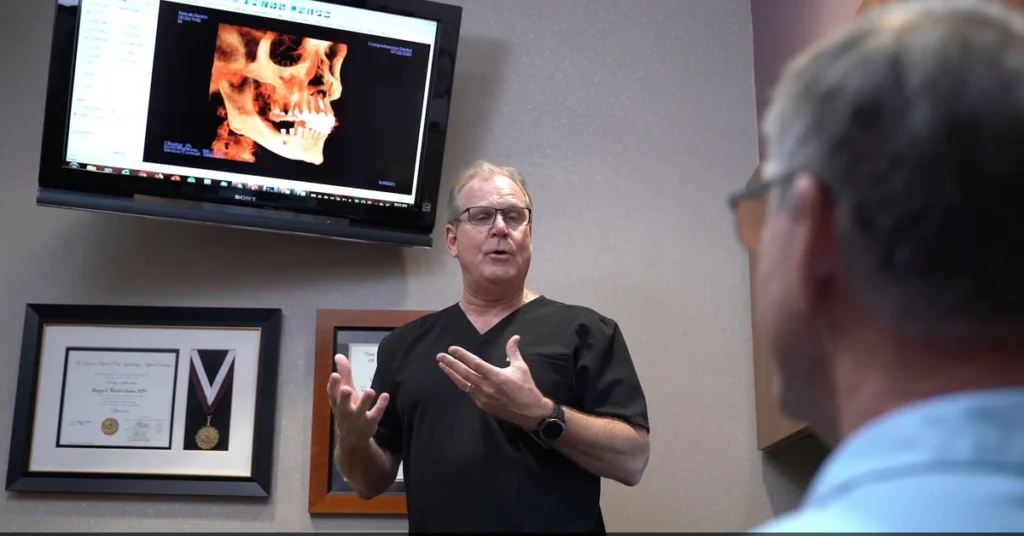
This is the question that matters most, and it can only be answered definitively with 3D cone-beam CT imaging – not a visual exam and not a standard panoramic X-ray. CBCT scans show bone volume, density, and topography in three dimensions, including proximity to critical structures like the inferior alveolar nerve and the sinus floor.
As a general clinical benchmark, implant placement requires a minimum of approximately 1 mm of bone on all sides of the implant post, with enough height to achieve adequate primary stability. When those dimensions exist, implants can often be placed directly without preparatory grafting. When they fall short, that’s where bone loss and dental implants options come in – and there are well-established procedures that rebuild what’s missing.
Two factors complicate the upper jaw specifically. The upper jaw tends to have lower bone density than the lower, which affects primary stability. And in patients with significant upper jaw bone loss, the maxillary sinus floor can drop to a level that leaves very little usable bone between the ridge crest and the sinus cavity. This is the clinical situation that makes sinus lifts necessary – and it’s more common than most patients realize.
| Bone Loss Level | Typical Approach | Added Timeline |
|---|---|---|
| Mild | Implants placed directly — no grafting needed | None |
| Moderate | Ridge augmentation or minor grafting at placement | 3–6 months |
| Significant (upper jaw) | Sinus lift before or at implant placement | 4–9 months |
| Severe | Block graft + staged implant placement | 6–12+ months |
Sinus Lift: The Solution for Upper Jaw Dental Implants With Bone Loss
A sinus lift – also called a sinus augmentation – is a surgical procedure that creates additional bone volume in the upper jaw by lifting the floor of the maxillary sinus and placing bone graft material in the space created. It’s the standard solution when there isn’t enough vertical bone height in the upper posterior jaw to support implant posts of adequate length.
The procedure is performed by entering the sinus through the lateral wall of the upper jaw, gently separating the sinus membrane from the bone floor, and packing graft material into the space. That material may be autogenous bone (from the patient), allograft (processed donor bone), xenograft (bovine-derived), or synthetic. Over the following months, the graft integrates and new bone forms – creating the foundation needed for dental implants with bone loss in the upper arch.
There are two primary approaches, and the choice depends on how much bone is currently present:
- Lateral window sinus lift – used when bone height is less than approximately 5 mm; requires a separate surgical stage before implant placement, with an integration period of 4 to 9 months
- Internal (crestal) sinus lift – used when bone height is 5 to 8 mm; in some cases can be performed at the same time as implant placement, shortening the overall timeline
Sinus lifts have a long track record in implant dentistry. The procedure has been refined over decades and, when performed with 3D imaging-guided planning, has high success rates. It adds time to the treatment sequence – but it makes implants possible for patients who would otherwise have no viable upper jaw option. For a complete breakdown of the procedure, recovery, and what to expect at each stage, see our detailed guide: complete sinus lift guide.
Bone Grafting: Rebuilding the Foundation for Dental Implants With Bone Loss
Bone grafting is the broader category of procedures that rebuild jaw bone volume in preparation for implant placement. A sinus lift is one specific type. There are others, each designed for different patterns of bone loss.
Socket preservation grafts are placed at the time of tooth extraction to slow the resorption that would otherwise begin immediately. These aren’t usually needed for patients who have already lost bone over years – but they’re an important tool when extraction is being planned before future implant placement.
Ridge augmentation addresses horizontal bone loss – when the jaw ridge has narrowed to the point where it can’t support an implant of adequate diameter. Graft material is placed against the existing ridge, covered with a membrane, and allowed to integrate. The result is a wider ridge that can receive a standard implant post.
Block grafts are used in more severe cases where significant amounts of both height and width need to be rebuilt. A block of bone – typically taken from another area of the jaw or from a donor source – is secured to the deficient area and allowed to integrate before implants are placed.
The right type of graft depends on the specific pattern of bone deficiency. A 2D X-ray can suggest bone loss but can’t show the 3D reality that determines which approach is appropriate. For full detail on our grafting procedures, materials, and recovery: bone grafting in Henderson.
Guided Surgery: Why Precision Planning Changes Outcomes for Bone-Loss Patients
For patients with compromised bone, the margin for error in implant placement is smaller than in a patient with abundant, healthy ridge bone. Placing posts too close to a nerve, angling them in a way that doesn’t optimize available bone volume, or missing the best position by a few millimeters – these aren’t just technique errors in bone-loss cases. They can mean the difference between successful integration and a failed implant requiring removal and additional intervention.
Guided implant surgery uses 3D CBCT data to plan the exact position, angle, and depth of each implant before surgery begins. That plan is translated into a surgical guide – a custom-fabricated device that physically constrains the surgical drill to the planned trajectory. The surgeon operates with information and precision that simply isn’t available in freehand placement.
For bone-loss patients specifically, guided surgery delivers four critical advantages:
- Maximizing available bone – the 3D plan places implants where the best bone is, even when volume is limited
- Avoiding critical structures – nerve canals and sinus cavities are precisely mapped before any incision is made
- Reducing surgical trauma – more precise placement means less disruption to surrounding tissue, supporting faster healing and better osseointegration
- Predictable outcomes – when plan and execution are aligned, the treatment sequence is more predictable for patients already committed to a multi-stage grafting process
Whether the bone beneath an implant is native or grafted, it can integrate with a titanium post when conditions are right. The key is placing that post correctly from the start. For more on the osseointegration process and what supports it: osseointegration and dental implants.
Frequently Asked Questions About Dental Implants With Bone Loss
Can you get implants with bone loss, or is it an automatic disqualification?
In most cases, bone loss is not an automatic disqualification. The relevant question is how much bone remains and what type of loss has occurred. Mild to moderate bone loss often doesn’t require preparatory grafting – there is sufficient residual bone to place implants directly. More significant bone loss typically requires a grafting procedure first. Severe bone loss in the upper jaw may require a sinus lift. Each scenario has a clinical path forward. A 3D cone-beam CT scan is the only way to accurately assess the situation. According to the American Academy of Implant Dentistry, bone grafting prior to implant placement is among the most common preparatory procedures in implant dentistry – a sign of how routinely this path is traveled.
How long does bone grafting add to the overall implant timeline?
The grafting timeline depends on the type and extent of the procedure. Minor grafting performed at the same time as implant placement adds little to no additional time. A standalone ridge augmentation typically requires 3 to 6 months of healing before implant placement can proceed. A lateral window sinus lift – used for significant upper jaw dental implants with bone loss – typically requires 4 to 9 months of integration. These timelines reflect the biology of bone formation, not complications. The overall treatment takes longer, but the result is a stable foundation that supports long-term implant function.
Does bone loss from gum disease affect implant candidacy differently than bone loss from tooth extraction?
Yes, in some ways. Bone loss from periodontitis tends to follow the pattern of the disease – more severe where infection was most active, sometimes irregular in distribution. Active periodontal disease must be resolved before implants can be placed, because the same bacterial environment that destroyed tooth-supporting bone can compromise implants. Bone loss from extraction-related resorption is more predictable in pattern. Both types of bone loss and dental implants options can be addressed with appropriate grafting, but the evaluation needs to account for the underlying cause, not just the current anatomy.
Is there a point where bone loss is too severe for any implant option?
In rare cases of truly extreme bone loss – after significant jaw trauma, certain medical conditions, or decades of untreated severe resorption – available bone may be insufficient to support standard implant protocols even after grafting. These cases are uncommon. For most patients asking about dental implants with bone loss, the answer is not “no” – it’s “let’s see exactly what we’re working with.” The only way to determine where a specific patient falls is through proper imaging and clinical evaluation, not an assumption based on a previous conversation.
What is the success rate of implants placed after bone grafting?
Implants placed in grafted bone have success rates comparable to those placed in native bone when the graft is properly executed, adequately healed, and the implant is placed with appropriate technique. The grafting procedure introduces a variable – the graft must integrate before implants can be placed, and occasionally a graft doesn’t achieve adequate volume on the first attempt. But when the process is completed successfully, the osseointegration process is the same whether the bone is native or regenerated. Long-term data on grafted-site implants supports their use as a reliable approach for patients who would otherwise lack the bone needed for can you get implants with bone loss to have a positive answer.
Bone Loss Doesn’t Have to Be the End of the Conversation
The most important thing I can tell a patient who has been told they don’t have enough bone for implants: get a proper evaluation before accepting that conclusion. A conversation, a panoramic X-ray, even a cursory exam – none of these substitute for the 3D imaging and clinical assessment that actually determines what’s possible.
Dental implants with bone loss are not a special category requiring something exotic. They’re the routine work of implant surgeons who do this every day. Bone grafting, sinus lifts, guided surgery – standard tools, not heroic measures. Most patients who walk in having been told there’s “not enough bone” walk out with a treatment plan.
Start with our full arch dental implants overview, or schedule a free evaluation at our Henderson or Las Vegas office. We’ll take the imaging, show you the actual anatomy, and give you a clinical answer – not a guess based on a visual exam or a general conversation about bone loss.