Teeth in a day procedures leave most patients with one question nobody answers clearly: what actually happens during those 4-6 hours, and what comes after? If you’ve been researching dental implants and keep seeing terms like “teeth in a day” and “24-hour permanent teeth” used interchangeably, you’re right to be confused – and right to want specifics before making a decision this significant.
After healing, patients who prefer a removable alternative may consider a horseshoe denture retained by implants, which leaves the roof of the mouth open while still using implant support.
After placing thousands of dental implants over the past two decades, I hear the same questions repeatedly. Are these procedures really the same thing? Can you actually get permanent teeth in one day? What’s the catch?
Here’s what this guide covers: the honest answer to what teeth in a day actually delivers, a true hour-by-hour procedure timeline, what your temporary teeth are and why they matter, exactly what to expect during week one of recovery, and a complete side-by-side comparison with traditional implant timelines.
What “Teeth in a Day” Actually Means
“Teeth in a day” and “24-hour permanent teeth” are marketing terms for the same procedure: immediate load dental implants with temporary teeth attached on the same day as surgery. Both describe the same clinical event.
Here’s what most practices won’t tell you. Those “permanent” teeth you get on day one are actually temporary prosthetics designed to carry you through the healing process. The truly permanent teeth come later – typically after 3-6 months of healing and osseointegration.
I learned to make this distinction clearly early in my career. A patient came in expecting his day-one teeth to last forever, and I had to explain why we needed to replace them with the final restoration. Clear communication about this is non-negotiable in our practice.
The Key Distinction
Day-one teeth = acrylic temporary prosthetic for healing. Final teeth = zirconia or porcelain permanent restoration placed at month 6-8. Both are part of the same teeth-in-a-day treatment plan.
Your Teeth in a Day Procedure: Hour-by-Hour Timeline
Most patients arrive knowing they’ll “get teeth the same day” but have no idea what those 4-6 hours involve. Here’s exactly what happens from the moment you walk in to the moment you leave.
Arrival and Pre-Op Preparation (7:30–8:00 AM)
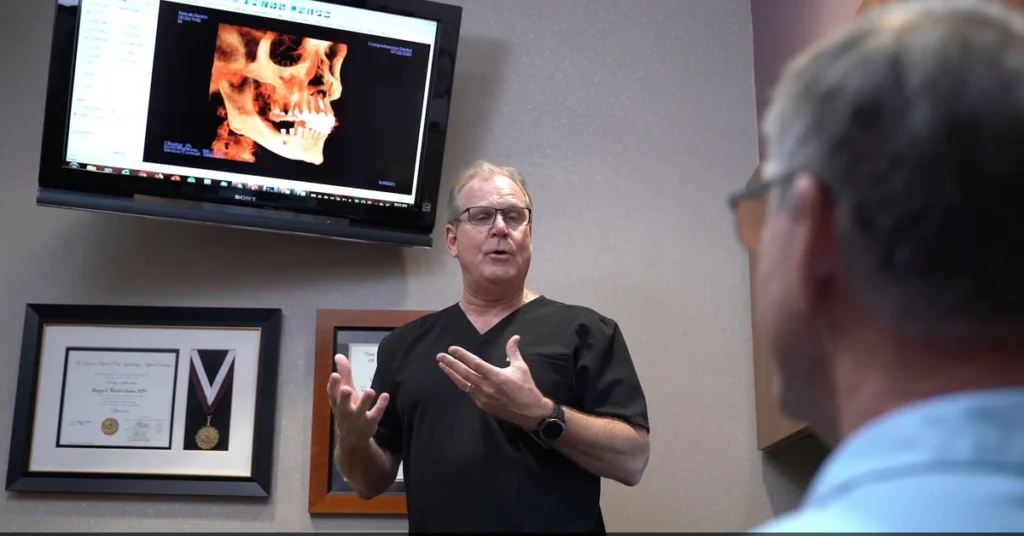
You’ll arrive having had nothing to eat or drink after midnight if you’ve chosen IV sedation – which most teeth-in-a-day patients do. Our team reviews your 3D CT scan one final time and confirms the implant placement plan. Your IV line is placed, and you’ll meet the on-site lab technician who will fabricate your temporary teeth throughout the day.
Anesthesia and Extractions (8:00–9:00 AM)
Once sedation takes effect, any remaining teeth that need removal are extracted first. This phase takes longer than most patients expect. We’re methodical about preserving as much bone as possible – the same bone that anchors your implants. If you’ve already lost all your teeth, this phase is skipped entirely.
Implant Placement (9:00–11:30 AM)
This is the surgical core of the teeth-in-a-day procedure. Depending on your treatment plan, 4-6 titanium implants are placed per arch. Each implant is positioned at a precise angle – often tilted to take advantage of available bone density and avoid critical anatomy like sinus cavities and nerve channels. Placement follows the surgical guide created from your CT scan, making this far more predictable than traditional freehand surgery.
We measure the stability of each implant before deciding whether immediate loading is appropriate. If any implant doesn’t achieve adequate initial stability, we adjust the plan. Your long-term outcome always matters more than same-day convenience.
Impressions and Lab Fabrication (11:30 AM–1:30 PM)
While you rest under sedation, impressions of your implants are taken and sent to the on-site lab. This is where many practices cut corners – a rushed temporary prosthetic that doesn’t fit well creates problems throughout healing. Our lab technician spends this time fabricating a properly fitted temporary arch that distributes bite forces evenly across all implants.
Temporary Teeth Attachment and Bite Refinement (1:30–3:00 PM)
The temporary prosthetic is attached to your implants and you’re brought out of sedation. We check your bite carefully through multiple small adjustments until it feels balanced. An uneven bite puts excessive force on individual implants and can compromise osseointegration – this step isn’t rushed.
Recovery and Discharge (3:00–4:00 PM)
You’ll spend an hour in our recovery area as sedation fully clears. You cannot drive – a responsible adult must pick you up. Before discharge, we review post-op care instructions, confirm your follow-up appointment 1-2 weeks out, and provide emergency contact information.
Procedure Day at a Glance
Your Temporary Teeth in a Day Prosthetic: What They Are and Why They Matter
The temporary prosthetic you leave with deserves a full explanation. Patients who understand its purpose take better care of it – and get better long-term outcomes with their teeth-in-a-day results.
What Temporary Teeth Are Made From
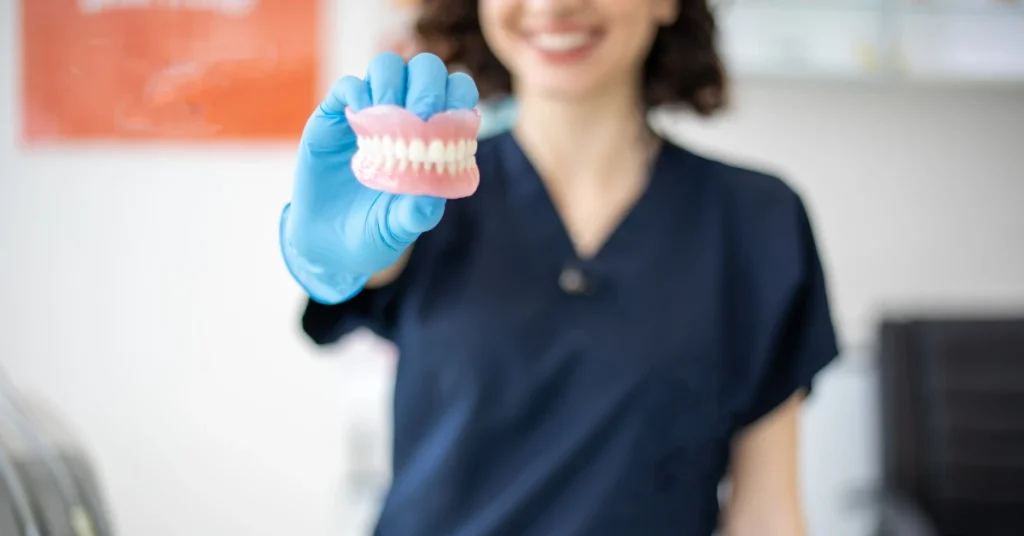
Day-one temporary teeth are fabricated from acrylic resin, occasionally reinforced with a metal framework for added strength. Acrylic is used – rather than the zirconia or porcelain in your final restoration – because it can be adjusted chairside. During healing, your gums reshape as swelling resolves and small fit adjustments are routine. With acrylic, those adjustments take minutes. With zirconia, they require sending the restoration back to an outside lab.
What Your Temporary Prosthetic Is Designed to Do
The temporary teeth in a day prosthetic serves four specific functions your final restoration does not:
- Protect healing tissue: The acrylic covers implant sites, shielding them from food particles and bacteria during the most vulnerable recovery window.
- Maintain facial structure: Without tooth support, the cheeks and lips begin collapsing inward within weeks. Temporary teeth hold everything in position while bone heals.
- Enable low-load function: The prosthetic allows soft food consumption while distributing forces carefully to avoid stressing implants before osseointegration is complete.
- Guide tissue contours: As your gums shape themselves around the prosthetic over several months, the temporary actively guides how tissue will contour around your final restoration.
What Temporary Teeth Cannot Do
This is where frustration develops when expectations aren’t set correctly. Your teeth-in-a-day temporary prosthetic is not designed for:
- Hard foods – no apples, crusty bread, raw carrots, or nuts
- Sticky foods – caramels and gum can dislodge or fracture acrylic
- Long-term wear – acrylic stains and wears faster than zirconia
- Full chewing force – a modified diet continues for 3-6 months
Patients who follow diet restrictions consistently report better outcomes with their final restorations. Those who don’t sometimes face complications that extend their overall teeth-in-a-day timeline.
What You’ll Experience on the Day of Your Teeth in a Day Surgery
Knowing what to expect physically and emotionally makes an enormous difference. Here’s an honest account of the day-of experience.
Before Sedation Takes Effect
Most patients arrive anxious – completely understandable for a procedure this significant. What surprises many is how quickly that anxiety fades once IV sedation begins. Within minutes of the medication starting, most patients feel deep calm before drifting off. You won’t be fully unconscious – IV sedation isn’t general anesthesia – but most teeth-in-a-day patients have little to no memory of the surgical phase when they wake up.
Waking Up With New Teeth
You’ll come out of sedation gradually, likely in a recovery chair with a blanket. Your mouth will feel numb from local anesthetic and you won’t fully feel your new teeth yet. Most patients want a mirror immediately – we always have one ready.
The emotional response at this moment is genuinely moving. Most patients cry. Some laugh. Many do both. Seeing a full smile for the first time in years – after missing teeth, dentures, or months of planning – is something we never take for granted witnessing.
The Ride Home and First Evening
You’ll be groggy for the trip home and for several hours afterward. Swelling begins within the first few hours, particularly in the jaw and lower face. Have ice packs ready and a comfortable place to rest. This is not a procedure where you return to work the same afternoon – plan for at least 2-3 days off.
Teeth in a Day Recovery: What to Expect During Week One
The first week is the most physically demanding part of the entire teeth-in-a-day process. Patients who understand what’s coming handle it far better than those who expected minimal discomfort.
Week 1 Recovery Timeline
Acute Recovery – Peak Swelling
Swelling peaks at 48-72 hours. Liquids-only diet. Ice 20 min on/off. Take pain medication on schedule, not as-needed.
The Turning Point
Visible improvement. Swelling begins reducing. Transition to soft foods – scrambled eggs, mashed potatoes, soft fish. Fatigue is normal.
Beginning to Feel Normal
Swelling largely resolved. Bruising fades. Speaking improves. Most desk-job patients can return to work. Diet restrictions still fully in effect.
⚠ Contact Our Office Immediately If You Experience:
- Fever above 101°F persisting beyond 48 hours
- Increasing pain after day 3 (pain should be declining)
- Significant movement or looseness in the temporary prosthetic
- Difficulty breathing or swallowing
- Unusual taste or discharge from surgical sites
Normal week-one experiences that don’t require a call: mild bruising, temporary difficulty speaking clearly, some temperature sensitivity, and minor bleeding that stops with gentle pressure.
Teeth in a Day vs. Traditional Implants: Complete Timeline Comparison
One of the most common questions I hear is how teeth in a day compares to traditional implants – not just in concept, but in actual calendar time. Here’s an honest side-by-side.
Traditional Implant Timeline (12–18 Months)
- Month 0: Consultation, CT scan, treatment planning
- Month 1–2: Extractions with a 6-8 week healing period before implant placement
- Month 2–3: Bone grafting if needed, followed by 3-6 months before implants can be placed
- Month 3–9: Implant placement surgery, then 3-6 months osseointegration without teeth – patients wear removable dentures
- Month 9–12: Abutments placed, impressions taken, final restoration fabricated
- Month 12+: Final teeth delivered
Teeth in a Day Timeline (6–8 Months)
- Week 1–2: Consultation, CT scan, treatment planning, temporary prosthetic design
- Day of surgery: Extractions, implant placement, temporary teeth attached – all one appointment
- Months 1–6: Healing with temporary teeth in place, follow-up every 4-6 weeks
- Month 4–6: CT scan confirms osseointegration is complete
- Month 5–7: Final impressions, permanent restoration fabricated
- Month 6–8: Final teeth delivered
| Factor | Traditional Implants | Teeth in a Day |
|---|---|---|
| Time without functional teeth | 6–12 months (removable dentures) | None – same day |
| Number of surgeries | 2–4 separate procedures | 1 procedure |
| Time to final restoration | 12–18 months | 6–8 months |
| Osseointegration time | 3–6 months | 3–6 months (same biology) |
| Recovery periods | Multiple, spread over 12+ months | One primary recovery (1–2 weeks) |
| Bone requirements | More flexible; grafting can precede implants | Sufficient bone required at surgery |
The critical thing to understand: the biology of osseointegration doesn’t change between procedures. Bone takes 3-6 months to integrate with a titanium implant whether temporary teeth are attached or not. What teeth in a day changes is your experience during that biological window – you go through healing with a functional smile instead of removable dentures.
If you’ve been quoted a 12-18 month traditional timeline, a second opinion is worth pursuing. Advances in implant angulation have made many patients eligible for immediate loading who wouldn’t have qualified a decade ago. Have your CT scan evaluated for teeth-in-a-day eligibility before committing to a longer traditional path.
Who Is a Candidate for Teeth in a Day?
Not everyone qualifies for teeth in a day, despite what some marketing materials suggest. The factors we evaluate at consultation include:
- Bone quality and quantity: Sufficient healthy bone is required for immediate loading. Long-term denture wearers may need bone grafting first.
- Overall health: Certain conditions and medications affect healing capacity. We review your complete health picture.
- Aftercare commitment: Success depends heavily on diet restrictions and follow-up compliance during the healing phase.
- Realistic expectations: Understanding that day-one teeth are temporary – with final results at 6-8 months – is foundational to satisfaction.
A 3D cone beam CT scan during your consultation tells us definitively whether you’re a teeth-in-a-day candidate. Many patients who assume they lack sufficient bone are surprised by what modern angulated implant techniques can achieve. According to the American Academy of Implant Dentistry, success rates for immediate load implants in properly selected patients are comparable to conventional implant protocols.
The Investment: What Teeth in a Day Costs
Here’s what you can realistically expect for teeth-in-a-day pricing in 2026:
- Full arch (upper or lower): $15,000 – $35,000 including surgery, implants, temporary teeth, and final restoration
- Bone grafting if needed: $500 – $3,000 per area
- IV sedation: $400 – $1,200
Most patients find the teeth-in-a-day investment worthwhile when comparing it to a lifetime of denture adjustments, adhesives, and the functional limitations that come with removable teeth. We review your specific insurance benefits at consultation and offer financing options that make the investment manageable.
Is Teeth in a Day Right for Your Situation?
After two decades of teeth-in-a-day procedures, here’s what I tell every patient: success depends on understanding the complete process – not just the surgical day. Yes, you walk out with a smile on day one. The real transformation happens over the months that follow as implants integrate and your final restoration is crafted to your exact specifications.
Patients who view the temporary phase as a purposeful step – not an inconvenience – consistently report the best outcomes. Find a provider who walks you through the entire teeth-in-a-day process with honesty: the temporary phase, the recovery expectations, and the long-term care involved.
Ready to find out if you’re a candidate? Schedule a free consultation at Comprehensive Dental Implant Center for a personalized assessment of your candidacy, timeline, and total investment.
Frequently Asked Questions About Teeth in a Day
How painful is the teeth-in-a-day procedure?
The procedure is performed under IV sedation, so most patients experience no discomfort during surgery. Post-operative soreness during days 1-4 is real – most describe it as significant pressure and achiness rather than sharp pain. Prescribed medications manage this effectively when taken on schedule rather than waiting for pain to peak.
Can I eat normally after getting teeth in a day?
Not immediately. The first 48 hours are liquids only, transitioning to soft foods by days 3-4. A modified diet – avoiding hard, crunchy, or sticky foods – continues for the full 3-6 month healing phase. Your final teeth-in-a-day restoration allows unrestricted eating with no ongoing limitations.
How long do the temporary teeth last?
Temporary acrylic prosthetics are designed to last 3-6 months through the healing phase. With proper care and diet adherence, they typically hold up well for that window. They aren’t designed for long-term use, which is why the permanent restoration is always the end goal of every teeth-in-a-day treatment plan.
What’s the difference between All-on-4 and teeth in a day?
All-on-4 is a specific implant protocol using four strategically angled implants per arch. Teeth in a day describes the immediate loading concept – placing temporary teeth the same day as surgery. Many All-on-4 cases are done as teeth-in-a-day procedures, but some teeth-in-a-day cases use more than four implants depending on individual bone anatomy and treatment planning.
Is teeth in a day covered by dental insurance?
Most plans provide limited coverage – typically for extractions or a portion of implant costs. Full-arch teeth-in-a-day procedures are rarely covered comprehensively. We review your specific benefits at consultation and discuss payment options. Many patients combine insurance benefits with monthly financing plans.
How do I know if I have enough bone for teeth in a day?
A 3D cone beam CT scan taken during your consultation provides a definitive picture of your bone volume and density. Many patients who assume they’re not teeth-in-a-day candidates because of bone loss are surprised – modern angulated implant techniques access bone that traditional approaches couldn’t reach. If bone grafting is needed, we’ll tell you exactly what that adds to your timeline and cost.