When people ask us about natural looking dentures, surgery is rarely their first worry. It’s teeth that look bought, the kind a stranger clocks from across a restaurant table.
That worry is fair. You’ve probably seen a set that gave itself away in a second, bright white and perfectly even in a face that’s clearly lived 60 years.
The fake look almost always comes down to a handful of design choices. You can check every one of them before your final teeth are made.
Below, you’ll find those choices, how shade and shape get decided, and the preview stage where you see the look before committing. If you’re weighing fixed teeth on implants, such as Hybridge full-arch restoration, it also covers what can still change after the implants go in.
5 Things That Make Dentures Look Fake at a Glance
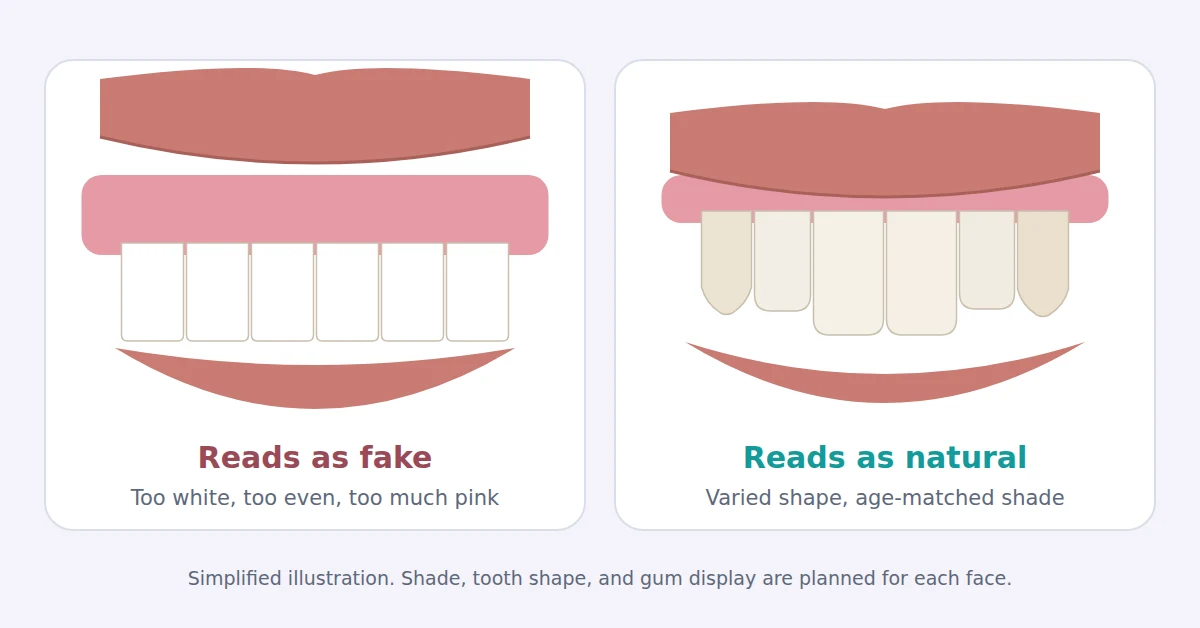
Nobody looks at a smile and thinks about shade tabs. They just register that something’s off, usually within a second or two. When a set of replacement teeth reads as fake, it’s nearly always one of these five.
- Too white. Brighter than the whites of the eyes, which natural teeth rarely are once you’re past your thirties.
- Too uniform. Every tooth the same color and length, lined up like piano keys.
- Wrong size for the face. Short teeth vanish under the lip, and oversized ones crowd the whole smile.
- Too much pink. A visible seam where replacement gum meets your own, or a wall of pink when you laugh.
- Unsupported lips. Teeth set too far back let the upper lip sink, which ages the whole face.
None of those five is about the material. Gorgeous lab work in the wrong shade still looks wrong, so shade is where to start.
Choosing a Denture Shade That Matches Your Age
Natural teeth get darker as you age. A 2024 meta-analysis of tooth color studies in Forensic Science, Medicine and Pathology put numbers on it. On a 0-to-100 lightness scale, the average slid from roughly 75 before age 30 to roughly 66 after 60.
Put brochure-white teeth on a 65-year-old face and the mismatch jumps out. Your skin, your hair, and the whites of your eyes have all aged together. Young teeth clash with all three.
Brightness matters more than the exact tint. VITA, the German company behind the shade guides most dental labs work from, calls lightness the most relevant shade dimension for getting a match right. A set that’s a little too warm usually passes, but a set that’s too bright almost never does.
A few habits help. Look at shade samples in daylight as well as under the bright dental lamp. Then hold them up at arm’s length, because nobody inspects your teeth from two inches away.
Wished for whiter teeth your whole life? Tell your dentist. There’s usually room to go a step lighter than your age would suggest without crossing into the fake zone.
A quick, honest note on materials. PMMA teeth on our Hybridge restorations can stain over time, while zirconia holds its color better. We manage that at cleanings, and a lab refresh brings back the original shade, a trade-off laid out in our zirconia and Hybridge comparison.
Tooth Shape, Size, and Where the Gum Line Sits
Real front teeth aren’t a matched set. The two in the middle are usually the widest and longest, and the pair beside them runs a little smaller.
Canines come to more of a point and sit slightly darker. Those small differences are much of what makes natural looking dentures pass as real teeth, even if you’ve never noticed them.
Tooth size also has to suit how your lips move. In a 2016 study of 265 adults published in The Angle Orthodontist, upper front teeth showed less with age, at rest and in a smile. Lower teeth showed more, and a design that ignores that pattern can look oddly young or oddly empty.
Then there’s lip support. The ADA’s MouthHealthy guide notes that facial muscles can sag after tooth loss, and that dentures can help fill out your face and profile. How far forward your new teeth sit decides how much of that support you get back.
Where the replacement gum meets your own
Fixed full-arch teeth usually include a band of pink material that replaces the gum and bone lost along with your teeth. The spot where it meets your natural gum is called the transition line. For a natural result, that line should stay tucked under your upper lip when you smile as wide as you can.
Your provider can check this by watching how high your lip rises when you laugh, not just when you pose for a photo. It’s one of the most important planning steps for a natural smile, and one of the least talked about.
The Preview Stage, Where You See Your New Smile Before It’s Final
Here’s the part many people never hear about. In a careful process, you see the look and weigh in before your final teeth are made. You usually get more than one chance to do it, too.
With traditional dentures, that chance is the wax try-in. Your teeth are set in wax so they can still be moved, and you try them in. Prosthodontists from UCLA list evaluating esthetics and speech at the try-in as core checks, along with the patient’s approval of the front teeth.
Fixed teeth on implants follow a different path. In our Hybridge cases, the lab designs where your teeth should sit before we choose implant positions. That way the look you want shapes the plan from day one.
After surgery, you wear temporary teeth for several months while the implants heal. That’s the stage where fit and appearance get checked before the final bridge is made.
Think of the temporaries as a rough draft you get to wear. Grin at the bathroom mirror, check the photos from Sunday dinner, and ask a blunt friend what they see.
A couple of weeks living with a smile tells you more than 10 minutes in the chair. It’s also your best shot at natural looking dentures instead of a set you merely tolerate.
What You Can Still Change at the Preview, and What’s Already Set
A preview only helps if you know what’s still on the table. Most of what makes teeth look natural can be adjusted before your final set is made.
Usually adjustable before the final teeth
- Shade and overall brightness
- Length of the front teeth and how much of them shows
- The shape of individual teeth, including small irregularities
- How far forward the teeth sit to support your lips
- The palate side of the upper teeth, which affects some speech sounds
Much harder to change once implants are in
- Where the implants sit in your jaw
- How much gum and bone you had to start with
- How the tooth material behaves over time, like PMMA’s tendency to stain
That second list is why the design conversation belongs before surgery, not after it. A plan built around where your teeth should be leaves more room to get the look right later.
6 Questions to Ask Before You Approve Your Natural Looking Dentures
Bring these to any consultation, ours included. A provider who’s comfortable answering them has usually built a preview into the process already.
- Will I see my new teeth, as a design or in temporaries, before the final set is made?
- Who picks my shade, and do we check it in daylight?
- How much upper tooth will show when my lips are relaxed? And when I laugh?
- Where will the transition line sit, and will my lip cover it?
- What can we still change after surgery, and does a change cost extra?
- How will this material hold its shade, and what does it take to restore it?
It also helps to look at finished work before you decide. Our before and after photos of Hybridge patients show real full-arch results, including a patient whose main wish was teeth that looked more natural.
Common Questions About Natural Looking Dentures
What are the most natural looking dentures?
Whichever set was designed around your face. Brand names matter less than shade, tooth shape, how much tooth shows, and lip support. Fixed teeth on implants have one extra edge, because they stay still when you talk or laugh.
Do natural looking dentures cost more?
Not necessarily, since a careful shade and design process is part of good treatment. The bigger price differences come from choosing a removable denture or fixed teeth on implants. Get the estimate in writing.
Can I choose a whiter shade than my natural teeth?
Sure, and plenty of people do. Trouble starts when you go far past what suits your age and skin tone. One or two steps lighter tends to read as healthy, but the very brightest tabs on the guide rarely do.
What if I don't like how my temporary teeth look?
Say so while you're still in temporaries. That's the stage meant for changes to shape, length, and shade, and your feedback goes into the final design. Once the final bridge is made, bigger changes usually mean remaking it.
Worried your new teeth will look fake? Natural looking dentures start with a design conversation, so bring that worry to your consultation. It’s free, there’s no pressure, and you can talk through shade, shape, and how much tooth should show for your face before any plan is final.