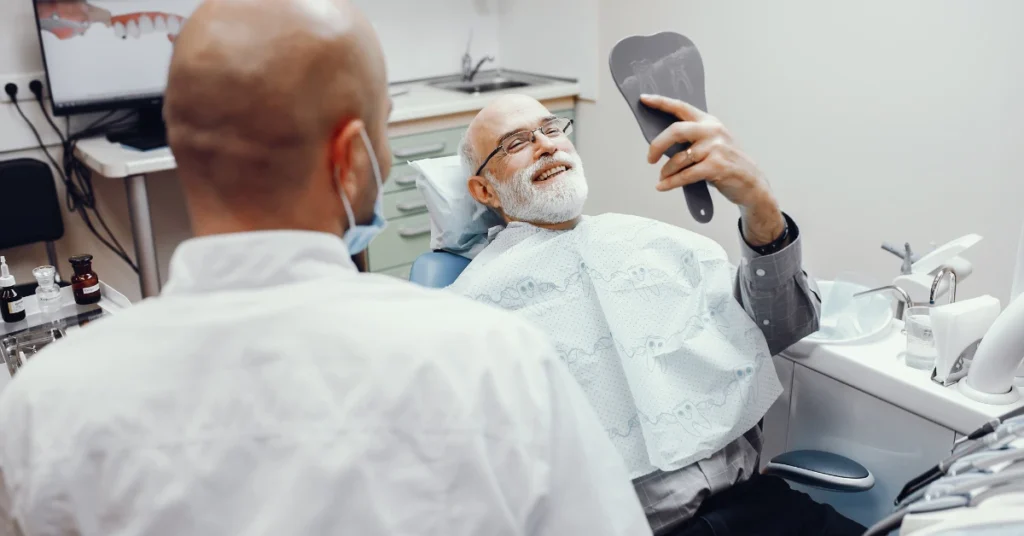
Stop accepting a life limited by dentures that slip, slide, and steal your confidence at the worst possible moments. If you’ve spent years managing adhesives, avoiding certain foods, and feeling self-conscious about your smile, you already know the truth – dentures were never meant to be your final answer. They were a bridge, and now it’s time to cross it.
After two decades of helping patients transition from dentures to dental implants, I’ve seen the same pattern repeat: people assume they are stuck because someone told them they lost too much bone, waited too long, or cannot handle the recovery.
That assumption is often wrong. Not always, and not without planning, but often enough that a 3D scan is worth doing before you rule yourself out.
Dental implants after dentures are often possible. The path depends on bone support, bite changes, gum health, and the kind of final teeth you want.
The useful first question
Do you have enough support for implants now, or do you need a staged plan first? Everything else comes after that.
Your dentures have been doing more damage than you realize. Not visible damage – the kind that happens silently, month after month, as your jawbone slowly disappears. This isn’t scare tactics. It’s basic biology, and it’s the single biggest factor that determines whether your implant journey will be straightforward or complex.
Why Your Jawbone Is Disappearing (And Why It Matters for Implants)
Let me be direct about something most dentists dance around. Every year you wear dentures, you lose approximately 25% of your jawbone width in the areas where teeth are missing. That’s not an exaggeration. That’s not a worst-case scenario. That’s the documented average rate of bone resorption for denture wearers, and it’s happening to you right now, whether you feel it or not.
Think about what that actually means. If you’ve worn dentures for four years, you’ve potentially lost the equivalent of an entire jawbone’s worth of width. The bone that once supported your natural teeth – the dense, strong foundation that allowed you to bite into an apple or chew a steak – has been slowly dissolving because there’s nothing stimulating it anymore.
Bone loss usually gets harder to manage with time. The signs are practical: thinner ridges, looser dentures, more adhesive, and more sore spots.
- Less bone can limit where implants fit.
- A changed bite can affect the final tooth position.
- Loose dentures can make the gums sore before treatment even begins.
Your natural teeth did more than help you eat. Every time you bit down, you sent signals through the tooth root into the jawbone. Those signals told your body, “This bone is needed. Keep it strong. Keep rebuilding it.” Dentures can’t replicate that process. They sit on top of your gums, and while they help you function, they’re doing nothing to preserve the bone underneath.
This is why dental implants after dentures aren’t just about upgrading your smile. They’re about stopping bone loss in its tracks. Implants function like natural tooth roots – they integrate with your jawbone and provide that crucial stimulation your body needs to maintain bone density. But they can only work if there’s enough bone left to support them.
The Bone Health Assessment: What Determines If You’re Ready
When someone walks into my office asking about implants after years of wearing dentures, the first thing we do – before discussing cost, before planning procedures, before anything else – is assess their current bone structure. This assessment tells us everything about what’s possible, what’s realistic, and what path forward will give them the best long-term results.
We use 3D CBCT imaging to create a complete map of your jawbone. Not just the surface. Not just the visible areas. We’re looking at bone density, bone height, bone width, and the proximity to critical structures like nerves and sinuses. This technology shows us exactly what we’re working with, down to millimeter-level precision.
What we’re specifically evaluating:
- Bone volume and density – Is there enough healthy bone to support implant posts, or will grafting be necessary to create a stable foundation?
- Bone quality throughout the jaw – Some areas may have retained better density than others, which affects where we can place implants and how we distribute forces
- Anatomical considerations – Where are your sinuses positioned? How much clearance do we have above the nerve canals in your lower jaw?
- Existing bone loss patterns – Understanding how and where bone has been lost helps us predict future changes and plan for long-term stability
- Soft tissue health – The gums and surrounding tissues that will support your implants need to be evaluated for thickness, attachment, and overall condition
Bone loss does not automatically disqualify you. It changes the plan.
Some patients can move directly into implant placement. Others need grafting, angled implants, or a longer healing sequence. The scan decides that. Guessing does not.
The Three Pathways from Dentures to Implants
Three Paths at a Glance
| Path | Best fit | What to ask |
|---|---|---|
| Direct implant placement | Patients with enough bone support for implant planning now. | Can temporary teeth be worn while the implants heal? |
| Implants with grafting | Patients with moderate bone loss who still have a workable path. | How much healing time should be expected before final teeth? |
| Advanced reconstruction | Patients with severe bone loss, bite collapse, or complex denture history. | Would a fixed full-arch bridge, implant denture, or staged plan be safer? |
Not everyone’s transition from dentures to implants follows the same route. Based on your bone assessment, you’ll typically fall into one of three categories, and understanding which pathway applies to you helps set realistic expectations for timeline, cost, and complexity.
Pathway One: Direct Implant Placement (Ideal Bone Preservation)
This is the straightforward scenario, and honestly, it’s becoming less common the longer someone has worn dentures. If you’ve maintained good bone density – usually because you transitioned to dentures relatively recently, or because you had implant-supported dentures that provided some bone stimulation – we can move directly to implant placement.
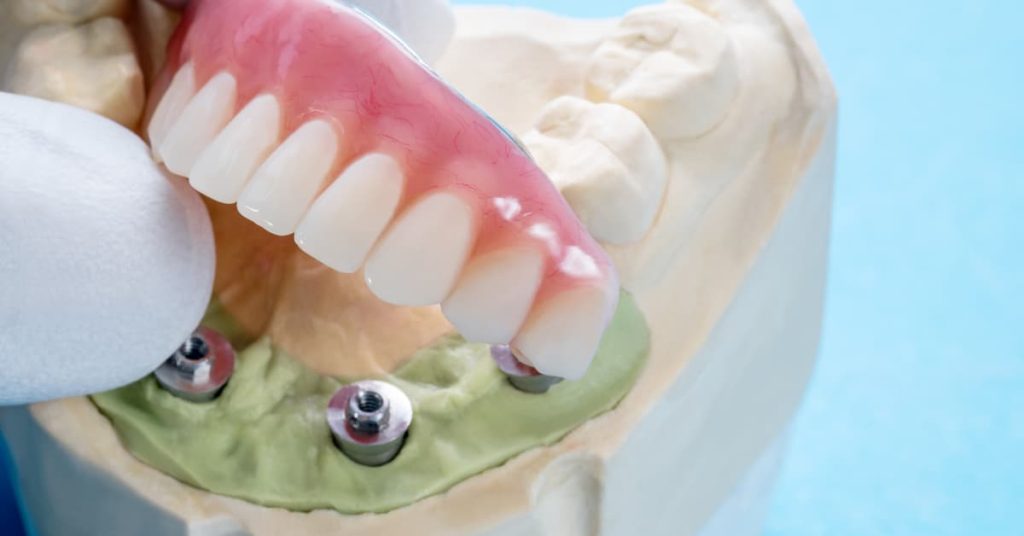
What this pathway looks like: We remove your dentures, place the implant posts directly into your existing bone, and in many cases attach temporary teeth the same day — a process often called teeth in a day — while your permanent restoration is crafted during the 3 to 6 month osseointegration period.
The key advantage here is time and simplicity. No additional procedures. No extended healing phases. We’re working with what nature gave you, and it’s sufficient to create a stable, long-lasting result.
Ideal candidates for this pathway typically haven’t worn dentures for more than 2 to 3 years, have maintained good overall health, and come from families with naturally strong bone density. If you’ve been diligent about wearing your dentures consistently (which actually helps maintain some bone through mechanical pressure), that also works in your favor.
For patients in this pathway, a Hybridge full arch restoration is often an excellent fit – a fixed, precision-engineered solution that takes full advantage of healthy bone to deliver lasting results.
Pathway Two: Implants with Bone Grafting (Moderate Bone Loss)
This is the most common scenario I see – patients who have worn dentures for 5 to 15 years and have experienced noticeable but not severe bone loss. You have a foundation to work with, but we need to enhance it to ensure long-term implant success.
Bone grafting sounds worse than it usually feels. The goal is simple: rebuild enough support for the implant position that makes sense for your final teeth.
- Some grafts are small and heal alongside other treatment steps.
- Others need several months before implants can be placed.
- The key question is whether grafting improves the final result enough to justify the extra time.
The grafting procedure happens in stages:
- Graft placement – We place the bone graft material in the areas that need reinforcement. This might be the upper jaw near the sinuses (sinus lift procedure), the ridge where teeth used to sit, or specific sites where implants will eventually go.
- Healing period – The graft needs 4 to 6 months to integrate with your existing bone. Your body gradually replaces the graft material with natural bone through a process called “bone remodeling.”
- Implant placement – Once the grafted area has healed and transformed into stable bone, we place the implant posts.
- Final osseointegration – Another 3 to 6 months for the implants to fuse completely with the bone.
- Permanent teeth attachment – The final crowns, bridges, or full arch prosthetics are attached to the implants.
Total timeline from start to finish: 9 to 14 months typically. Yes, that’s longer than direct placement. But here’s what patients need to understand – we’re not just placing implants. We’re rebuilding a foundation that will support those implants for decades. Rushing this process leads to implant failure, and nobody wants to go through this twice.
During every phase of this pathway, you’ll have functional teeth. We provide temporary solutions that let you eat, speak, and smile normally while your bone heals.
Pathway Three: Advanced Reconstruction (Severe Bone Loss)
Some patients come to me after wearing dentures for 20+ years, or after having particularly aggressive bone loss due to genetics, health conditions, or previous dental trauma. In these cases, we’re looking at significant bone deficiency that requires more advanced reconstruction techniques.
This pathway might involve multiple bone grafting procedures, possible use of zygomatic implants (longer implant posts that anchor into the cheekbone rather than the jawbone), or All-on-4/All-on-6 techniques that strategically place implants at specific angles to maximize contact with remaining bone.
All-on-4-style treatment can help when bone is limited because angled implants may use stronger areas of the jaw. That does not make it the right answer for every denture wearer.
The better question is whether the implant positions support the teeth you actually need. CIC plans from the final smile backward, not from the bone alone.
Timeline for advanced reconstruction varies significantly based on individual cases. Some patients complete the journey in 6 to 8 months using All-on-4 techniques. Others with complex grafting needs might take 18 to 24 months to achieve final results.
What I always tell patients in this category: severe bone loss doesn’t mean you can’t have implants. It means we need to be more creative and methodical about how we approach it. And the results – when done correctly – are just as successful and long-lasting as any other pathway.
Reestablishing Your Bite: More Complex Than You’d Think
Here’s something that doesn’t get discussed enough in implant consultations: your bite has changed dramatically since you started wearing dentures. The way your jaws come together, the position of your jaw joints, even the muscle memory your chewing muscles have developed – all of it has adapted to denture function, which is fundamentally different from how natural teeth work.
When I’m planning your implant placement, I’m not just thinking about where to put posts in bone. I’m engineering a complete functional system that will distribute forces correctly, allow efficient chewing, and position your jaw in its optimal relationship for long-term joint health.
This is called “occlusal rehabilitation,” and it’s one of the most critical aspects of successful implant dentistry that too many practitioners overlook.
What we’re specifically addressing:
- Vertical dimension of occlusion – Over years of wearing dentures, your bite has likely “collapsed” as bone loss progressed. Your upper and lower jaws sit closer together than they should, which can cause TMJ issues, facial pain, and premature wear on any dental work. Implants let us restore proper jaw spacing.
- Centric relation positioning – There’s an ideal position where your jaw joints, muscles, and teeth all work in harmony. Dentures rarely maintain this position because they shift and move. Implants are fixed, which means we need to establish correct positioning from the start.
- Force distribution patterns – Natural teeth have slight mobility that helps absorb chewing forces. Implants don’t move at all. We need to design your new teeth so that forces distribute evenly across all implants, preventing overload on any single point.
- Anterior guidance – When you move your jaw side to side or forward, your front teeth should guide the movement and allow your back teeth to separate slightly. This protects your back teeth and jaw joints from harmful lateral forces. We build this guidance into your implant-supported teeth.
During your implant planning, we take detailed records of your jaw movements, photograph your face from multiple angles, and often create diagnostic models to test different bite positions before committing to final implant placement. This isn’t perfectionism – it’s prevention. Getting your bite right the first time prevents years of potential problems with jaw pain, implant complications, and prosthetic failures.
Some patients worry this sounds overly technical or that it’ll take forever to “learn” their new bite. Here’s the reality: your body adapts remarkably quickly to a properly engineered bite. Within weeks, the correct bite feels completely natural. It’s incorrect bites that cause ongoing problems – constant adjustments, persistent discomfort, and that nagging feeling that “something isn’t right.”
What Nobody Tells You About the Transition Period
The consultation is done. The treatment plan is mapped out. You’ve committed to moving forward with implants. And then comes the part that catches most patients off guard – the actual transition period between your old life with dentures and your new life with implants.
This isn’t just about physical healing. It’s about managing expectations, maintaining function, and understanding that transformation doesn’t happen overnight – but when it does happen, it’s permanent.
During healing, you may wear temporary teeth designed for the transition period. They are not just your old denture reused without thought.
The temporary plan should protect healing sites, help you function, and make the timeline feel manageable.
Healing is usually more manageable when expectations are clear:
- Swelling or tenderness during the first week.
- Temporary food limits while implants integrate with bone.
- Checkups to monitor healing and adjust temporary teeth.
- Small bite or fit changes as the gums settle.
What you definitely won’t experience: being without teeth at any point. Having to miss work for extended periods (most patients return to work within 2 to 3 days after implant placement). Unbearable pain (modern techniques and anesthesia have made implant surgery remarkably comfortable). Social embarrassment from visible healing or temporary teeth (our temporaries are designed to look natural and function well).
The psychological shift during this period matters more than most people anticipate. You’re moving from something removable and temporary (dentures) to something permanent and fixed (implants). That mental adjustment – going from “these teeth might slip” to “these teeth are part of me” – takes time. Some patients adapt within days. Others need a few weeks to fully trust their new teeth.
Progress can feel gradual. One week you notice less movement. Another week you try a food you had been avoiding. Then one day you realize you have not thought about your teeth all afternoon.
The Cost Reality (And Why It’s Actually an Investment)
Let’s address the question that’s been on your mind since you started reading: what does this actually cost?
Dental implants after dentures typically range from $15,000 to $50,000+ depending on how many implants you need, whether bone grafting is required, and the complexity of your case. That’s not a small number, and I’m not going to pretend it is. But context matters, and here’s the context most dentists don’t provide.
Dentures often need replacement, relines, adhesives, and repair visits. That does not make implants cheap. It does mean the comparison should include more than the first denture fee.
Cost comparison check
- How often have your dentures needed adjustment?
- How much are adhesives, relines, and replacements costing over time?
- What would a stable implant-supported option change day to day?
But here’s what really matters: this isn’t about comparing line items on a price sheet. It’s about quality of life.
The financial question matters. So does the daily one: what would change if you could eat, speak, and laugh without checking whether the denture moved?
I’ve had patients tell me that getting implants changed their personality. Not in some dramatic, unrecognizable way – but in subtle, profound ways. They became more social. More confident. More willing to try new experiences. They stopped planning their lives around their teeth and started living freely.
That’s not marketing language. That’s what I hear in follow-up appointments months and years after treatment is complete. And that’s the investment you’re actually making – not in teeth, but in removing a constant limitation that’s been defining your choices for years.
Financing can make treatment more manageable, but it should not distract from the treatment plan itself. Compare the clinical plan first, then compare payment options.
Why Waiting Costs You More Than Money
Every month you delay transitioning from dentures to implants, you lose bone that you’ll never naturally regain. That bone loss directly correlates to treatment complexity, cost, and timeline. A patient who comes to me after 5 years in dentures typically needs less grafting (or no grafting) compared to someone who’s waited 15 years. Less grafting means fewer procedures, shorter healing times, and lower total costs.
There is also the practical cost of waiting: more meals avoided, more sore spots managed, more time adjusting to a denture that keeps changing fit.
Those moments don’t come back. The time you spend waiting is time you spend living with limitations you don’t have to accept.
I see this pattern constantly: patients who finally commit to implants after years of considering it universally say the same thing – “I wish I’d done this sooner.” Not once in 20 years have I had someone tell me they regret getting implants. The regrets are always about waiting too long.
Bone loss does not pause while you think about treatment. That is not a pressure tactic. It is the reason a scan matters sooner rather than later.
I’m not trying to pressure you. I’m trying to give you information that most dentists soft-pedal because they’re worried about seeming aggressive. But you deserve the truth: timing matters significantly in implant dentistry, and bone loss is not your friend.
Bring this to the consultation
- How long you have worn dentures and what has changed with the fit.
- Which foods you avoid because the denture moves or hurts.
- Whether your upper denture covers your palate and affects speech or taste.
- What you need most: better chewing, a fixed option, fewer sore spots, or a more natural feel.
Taking the First Step: What Happens at Your Consultation
If you’re ready to explore whether dental implants after dentures are right for you – or even if you’re just ready to understand what’s actually possible in your specific situation – here’s what happens when you come to Comprehensive Dental Care for a consultation.
First, we listen. Not to your teeth, to you. What are your frustrations with dentures? What are you hoping implants will let you do? What are your concerns about the process? What questions keep you up at night? This isn’t a sales consultation where I’m trying to convince you of anything. It’s a diagnostic conversation where we’re establishing what success looks like for you specifically.
Then we examine. We look at your current dentures – how they fit, where they’re causing problems, how worn they are. We examine your oral tissues – gum health, any areas of irritation or bone prominence, soft tissue thickness. We assess your bite relationship and jaw function. All of this before we even get to imaging.
The 3D CBCT scan gives the team a map of your bone, nerves, sinuses, and implant options. It is the difference between guessing and planning.
- Bone width and height
- Sinus and nerve position
- Possible implant angles
- Whether grafting is needed
Based on everything we’ve learned, I present your options. Not just the “ideal” option, but the full range of possibilities that could work for your situation. We discuss pathways, timelines, and realistic expectations for each approach. We talk about costs and financing. We address every question you have, and the ones you haven’t thought to ask yet.
Then you go home and think about it. There’s no pressure to decide immediately. This is too important a decision to make in the moment. Take time. Talk to family. Review the information. Come back with more questions if you need to.
When you’re ready to move forward, we schedule your treatment in phases. Each appointment has a clear purpose. Each healing period has specific guidelines. You’re never left wondering what happens next or feeling uncertain about the process. We’ve done this hundreds of times, and we’ll guide you through every step.
Your mouth is the gateway to your body. What happens there affects your nutrition, your confidence, your social connections, your overall health, and your quality of life. Dentures were never meant to be a permanent solution – they were meant to be a bridge to something better. Dental implants are that something better, and they’re more accessible than you probably think.
The bone you have today is the most you’ll ever have if you stay in dentures. Every day forward represents less bone, more complexity, and more limitations. But every day forward also represents an opportunity to choose something different.
Call Comprehensive Dental Care in Henderson or Las Vegas today. Schedule your consultation. Come see what’s actually possible for your specific situation. No pressure, no sales pitch – just honest information from a dentist who’s been helping people make this transition successfully for two decades.
Your journey from dentures to implants starts with a single conversation. Let’s have that conversation.
Can You Get Dental Implants After Wearing Dentures?
Yes, many people can get dental implants after wearing dentures. The real question is not whether dentures disqualify you. It is how much bone support remains, how your bite has changed, and whether your mouth needs grafting or a staged plan before final teeth are attached.
That is why the consultation matters. A denture-to-implant plan should start with 3D imaging, a bite evaluation, and a practical conversation about timeline, cost, and temporary teeth.
What to Expect When Moving from Dentures to Implants
The transition is not the same for every denture wearer. Some patients can move into implant planning quickly. Others need grafting, infection control, bite correction, or a healing period first.
A good consultation should answer these before you leave
- How much bone is available in the upper and lower jaw?
- Can temporary teeth be worn during healing?
- Would a palateless denture, implant denture, or fixed bridge solve the main problem?
- Would full-arch dental implants or Hybridge full-arch restoration create a more stable result?
Dentures vs Implants: Timeline and Cost Comparison
Dentures can look less expensive because the entry cost is lower. Over time, relines, adhesives, replacement dentures, sore spots, food limits, and bone loss can change the real cost. Implants usually cost more upfront, but they are planned around a more stable foundation.
| Question | Staying with dentures | Moving toward implants |
|---|---|---|
| Starting cost | Usually lower. | Usually higher because surgery, imaging, and final teeth are involved. |
| Ongoing costs | Relines, adhesives, repairs, and replacement dentures can add up. | Maintenance still matters, but the plan is built around an implant-supported foundation. |
| Bone support | Dentures do not replace tooth roots, so jawbone can keep shrinking. | Implants can help support the jaw by replacing tooth-root function. |
| Timeline | Adjustments may be needed whenever fit changes. | Treatment can take months if grafting or healing is needed, but the endpoint is more stable. |
How to Think Through the Decision
Start with what bothers you most: a loose lower denture, a covered palate, sore gums, avoiding certain foods, or worrying that the denture will move when you talk. The right plan should solve the problem you actually feel every day.
For one patient, that may mean a better removable option. For another, it may mean a fixed full-arch bridge. That difference matters. Not every denture wearer needs the same next step.
Frequently Asked Questions: Dental Implants After Dentures
Can I get dental implants even if I have worn dentures for many years?
Often, yes. Wearing dentures for years can reduce jawbone volume, but it does not automatically rule out implants. A 3D scan shows whether you can move directly into implant planning or need grafting, angled implants, or a staged plan first.
Why does wearing dentures cause bone loss?
Dentures sit on top of the gums. They do not replace tooth roots, so the jawbone no longer gets the same chewing pressure it once had. Over time, the bone can shrink and the denture fit can keep changing.
Do I need bone grafting before dental implants?
Maybe. Some denture wearers still have enough bone for implants. Others need grafting or a different implant position. CIC uses imaging to make that call instead of guessing from how long you have worn dentures.
Will I be without teeth during the implant transition?
Most patients want this answered early, and they should. Temporary teeth may be possible during healing, but the exact plan depends on bone support, implant stability, and the type of final restoration being made.
How long does it take to transition from dentures to dental implants?
The timeline depends on the path. A direct case may take several months. A grafting or reconstruction case can take longer because the mouth has to heal before final teeth are made. The consultation should explain the likely sequence before you commit.
Why should I not wait to replace dentures with implants?
Waiting can allow more bone loss, which may make treatment more involved later. That does not mean everyone needs to rush into surgery. It does mean a scan and treatment conversation are worth having before the denture fit gets worse.
How do you switch from dentures to implants?
The process starts with 3D imaging, a bite evaluation, and a discussion about what bothers you most about dentures. From there, the dentist maps out whether you need direct implant placement, grafting, temporary teeth, or a full-arch plan.
Are implants better than getting new dentures?
They can be if you want better chewing stability, less movement, and less dependence on adhesives. New dentures may still be the right choice for some patients, but implants usually offer a more stable foundation when the patient is a candidate.
Ready to See If Implants Can Replace Your Dentures?
Get a free consultation with imaging included. CIC can check bone support, bite changes, temporary teeth options, and whether a fixed full-arch plan makes sense for you.
Schedule Your Free Consultation
(702) 960-1983 | Open Weekdays | Henderson & Las Vegas