If you’re searching for “full mouth extraction,” you probably already have a picture in your head. Walking out of a dental office with no teeth, then weeks of hiding your mouth. For most people, that picture is the hardest part of the decision.
Whether you go home with teeth is decided before the appointment, at the consult. “Leaving with teeth” can mean one of three different things, and which one applies to you depends on your bone, your health, and what you and your dentist plan together. This article explains the three, what the day itself involves, what the first two weeks feel like, and which questions only an exam can answer.
Why a Dentist Recommends Removing All of Your Teeth
Nobody takes out a full arch lightly. The ADA’s patient guidance says teeth come out for disease, trauma, or crowding. Cleveland Clinic puts it another way: a tooth comes out when nothing else can save it. Full clearance is that same decision made one tooth at a time across the whole jaw. Usually it’s years of gum disease, decay under old crowns, or teeth loose enough that a denture would already fit better than what’s there.
“I just want them all out” is a common way to arrive at this. People come in worn down by pain and by repairs that cost money every six months and never seem to end. Wanting the fight over is a reasonable place to start. It isn’t the exam.
The exam goes tooth by tooth. A tooth with solid bone and a fixable problem has a future. A tooth that wobbles with no bone around it doesn’t. A good treatment plan tells you which teeth could stay and why they shouldn’t, even when the answer turns out to be all of them.
What a Full Mouth Extraction Appointment Is Like
Taking out a whole arch is a longer appointment than taking out one or two teeth, with more bleeding to manage and more swelling afterward, and the schedule for the day reflects that.
Anesthesia gets decided at the consult, not on the day. Local anesthetic at every site is standard. Sedation is an option on top of that, and choosing it means bringing someone who can drive you home and stay with you afterward.
Once you’re numb, each tooth is loosened and lifted out of its socket. With a whole arch that takes a while. Under local anesthetic you feel pressure and movement, not sharp pain. With sedation, most people remember very little of it.
After the last tooth, the sockets are cleaned and the ridge of bone is smoothed so a denture or implants can sit on it evenly. What happens next was decided at the consult, and it’s one of three things.
Will You Leave With Teeth? The Three Things That Can Mean
“Same-day teeth” can mean any of the three below, and they’re very different things to live with. One comes out at night, one doesn’t, and one you won’t have for months. Before you agree to anything, make sure you know which one you’re being offered.
Removable immediate denture
Comes outPlacedThe same day, as soon as the last tooth is out
How long you have itUntil it’s relined or replaced, around six months
What decides itCandidacy, assessed before surgery
Fixed temporary teeth on implants
Stays inPlacedThe same day or within the week, screwed to the implants
How long you have itThrough implant healing
What decides itImplant stability, measured during surgery
Final restoration
Fixed or removablePlacedMonths later, after the bone has settled
How long you have itYears
What decides itHealed bone and the plan you chose
The removable immediate denture
This is what most of the “full mouth extraction with immediate dentures” results online are describing. The denture is made before surgery from impressions of your mouth, and it goes in the moment the last tooth is out. The University of Iowa’s College of Dentistry describes it acting like a bandage over the fresh sockets, protecting the tissue and reducing bleeding. You leave with teeth, and you never have to be seen without them.
The downside is fit. The denture was made for a mouth that still had teeth in it, and as the gums shrink over the following weeks it starts to loosen. Your dentist adds a soft lining to take up the slack, and at around six months you get either a permanent reline or a new denture. Not everyone is a candidate for an immediate denture, and the University of Iowa says so directly.
Fixed temporary teeth on implants
This is what we mean by teeth in a day.
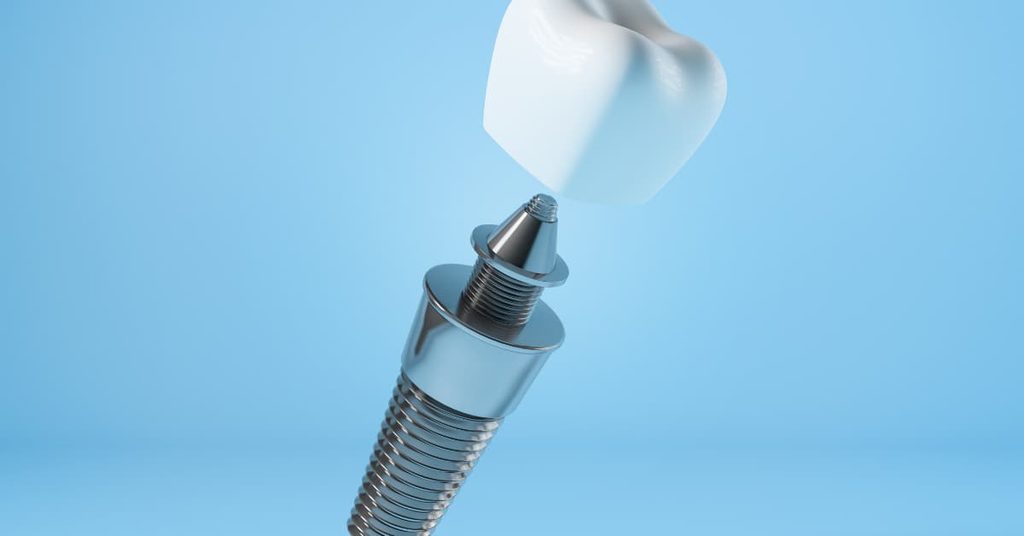
An implant is a small titanium post that goes into the jawbone and does the job a tooth root used to do. Once the teeth are out, several of them are placed into the bone in the same sitting, in the spots where the bone is strongest.
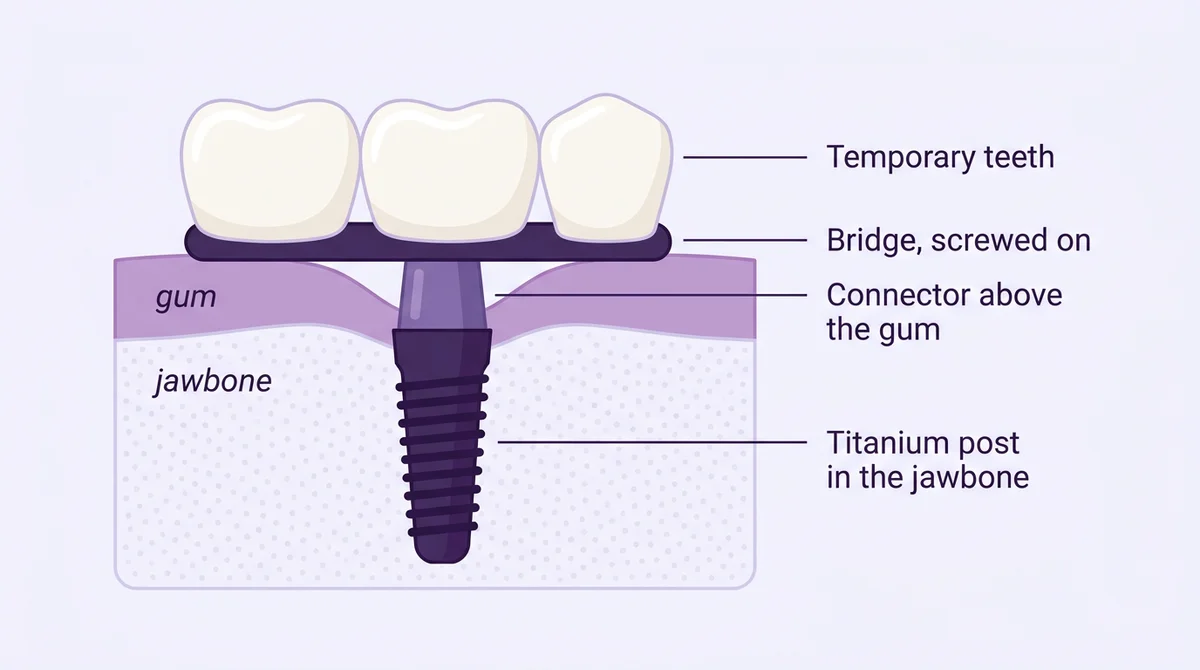
Each implant is then tested to see how firmly it’s holding. If they all pass, a temporary bridge is screwed onto them, either that day or within the week, and it stays in. You don’t take it out at night, and you leave with fixed teeth.
Those teeth are made to carry you through healing. The final set comes later, once the bone has grown around the implants. That “if” is the subject of the next section.
The final teeth
An immediate denture and a temporary bridge are both stand-ins. Your permanent teeth, fixed or removable, are made months later, after the bone has finished changing shape. Teeth made on extraction day won’t fit the mouth you’ll have six months later.
One thing advertising tends to skip: placing an implant on extraction day and putting teeth on it are two separate decisions.
The International Team for Implantology, which sets the terms the profession uses, defines them separately. Immediate placement means the implant goes into the socket the same day. Immediate loading means a bridge is attached to it within a week. You can have the first without the second, and plenty of patients do.
Our never toothless approach keeps fixed teeth in place from day one whenever the plan supports it. When it doesn’t, you should know ahead of time what happens instead.
What Happens if the Implants Can’t Be Loaded That Day
An implant has to be holding firmly in the bone before it can support a bridge. That gets tested on every implant during surgery. An implant that isn’t firm enough is left in place to heal on its own, without teeth attached, and gets restored once it’s solid.
The plan can change on the day if your body isn’t likely to heal well, if an implant isn’t stable enough, or if the jaw turns out to need bone grafting first. The ITI’s guidance says both the placement plan and the loading plan should be decided before any tooth comes out, with the alternative already agreed as part of your consent.
Ask at the consult what happens if an implant can’t be loaded, and whether you’ll have teeth while you wait. You should hear that answer before extraction day.
A systematic review of full upper arches loaded immediately found only weak evidence of any difference between loading right away and waiting. The studies behind it were small and used carefully selected patients, and the authors said the results couldn’t be applied to badly shrunken upper jaws that need grafting. So the decision gets made during surgery, one implant at a time. Nobody can promise it beforehand.
The First 72 Hours After a Full Mouth Extraction
What the first two weeks usually look like
Call the office if you’re still getting worse after day four, if bleeding won’t slow with gauze pressure, if pain isn’t touched by your medication, or if you have a fever.
You go home with gauze packed over the sites and a mouth that’s still numb. Rest for the remainder of that day.
Some oozing is normal through the first day. Cleveland Clinic’s instruction is to fold a piece of gauze over the site, close down gently on it for 15 minutes, and repeat until the bleeding slows. If you have an immediate denture, it’s covering the sockets and helping with this, and your surgeon will tell you whether to leave it in overnight. Follow that instruction over anything you read here.
A blood clot forms in each socket, and healing starts from that clot. Suction can pull it out, so no straws for the first 24 hours, no smoking, and no hard rinsing.
Take the first dose of pain medication before the numbness wears off, with some food in your stomach. Taking it early works better than waiting for the pain to start. If you were given antibiotics, finish them.
Hold an ice pack against your face over the surgical area, 20 minutes on and 20 minutes off, through the first day. Swelling and bruising will keep building after that. Post-operative instructions from oral surgery practices such as PNW Oral and Maxillofacial Surgeons put the peak on day three or four, with steady improvement from there. Feeling worse on day three than on day one is normal. If you’re still getting worse on day six, call the office.
Eat soft, cool food that doesn’t need chewing. Yogurt, smoothies with a spoon, soup that isn’t hot. You’ll be more tired than you expect, and skipping meals slows healing.
The First Two Weeks
From day four or five the swelling goes down, and any bruising changes color on its way out. Starting the day after surgery, brush twice a day, gently around the sites, and rinse with warm salt water three or four times a day for a week to ten days. No smoking for at least five days. Alcohol stays off while you’re on pain medication.
If you have an immediate denture, your speech will sound strange for a few days and then settle. The University of Iowa’s dental school points out that getting the denture in right away means you adjust to speaking with it once, instead of learning to talk without teeth and then relearning with a denture later. You’ll have adjustment visits as the gums change shape under it. Those visits are a normal part of wearing an immediate denture.
Cleveland Clinic says most people are back at work or school a day or two after a single extraction, and physical jobs need longer. A full arch under sedation is a bigger operation, so plan on more time off. How much more depends on your job, your health, and how the surgery went.
Everything past two weeks, including how the implants integrate and when final teeth get made, is on our full-arch implant recovery page.
What Your Gums and Bone Are Doing Underneath
Each empty socket heals from the bottom up. New tissue fills it in over a few weeks, and for a while you might see or feel a small dip where the tooth was. Cleveland Clinic describes that dip as a normal stage of healing.
The bone underneath changes more slowly. Once there are no roots to hold, the jawbone in that area gradually shrinks, and the ridge your denture or bridge sits on gets lower and narrower over the following months. This is the reason an immediate denture loosens and needs relining. It’s also the reason your permanent teeth aren’t made until the bone has settled.
Call the office if you notice any of these:
- Pain that gets worse around day four or five while everything else is improving. That’s the pattern of a dry socket, where the clot has come out and left bone exposed.
- Bleeding that won’t slow with gauze pressure.
- Swelling that’s still growing after day four.
- Pain your medication doesn’t touch, or a fever.
The AAOMS, the professional body for oral surgeons, lists the same warning signs in its post-operative guidance. When in doubt, call and describe what you’re seeing.
What a Full Mouth Extraction Costs
The cost depends on how many teeth are coming out, whether you’re sedated, whether the jaw needs grafting, and which of the three replacement options you’re having. Any estimate you’re given should break those out separately, and it should say whether the price covers both the temporary teeth and the final teeth or only the first set. Our full mouth dental implant cost page covers the typical ranges and what changes them.
Planning Your Extraction Day at Comprehensive Implant Center
Henderson, Nevada
Find out which of the three you’re a candidate for
- A 3D scan and a tooth-by-tooth look at what you have left
- Which teeth could stay, and why the rest shouldn’t
- Which replacement option your bone and health support
- What happens if an implant can’t be loaded on the day
- The whole plan and its cost, in writing
The consultation is free, and it’s where you find out whether the day you’re picturing has to happen at all.
Schedule your free consultationAnswers to Common Questions About Full Mouth Extractions
Do you get dentures the same day as a full mouth extraction?
Yes, if an immediate denture was made before surgery and you’re a candidate for one. It goes in as soon as the last tooth is out. It will need relining or replacing once your gums and bone have changed shape, usually around six months.
How long does a full mouth extraction take?
It depends on how many teeth are coming out, how difficult each one is, and whether implants go in during the same visit. A full arch is a longer appointment than a few extractions, so plan the whole day around it.
Do you have to wear an immediate denture the first night?
Ask your surgeon before you leave. The denture protects the sockets and helps control bleeding, so many surgeons want it left in at first. The answer depends on how it was fitted and what’s underneath it.
Can I get implants the same day my teeth are pulled?
Often, yes. Whether a fixed temporary bridge goes on them the same week is a separate decision that depends on how stable each implant is in the bone. A good plan says in writing what happens if they aren’t.
Questions about your own situation? Schedule your free consultation