Patients bring me treatment estimates from other offices most weeks. Half the time, the words on the page don’t match the words they heard at the consult.
Hybrid denture is one of the worst offenders. It’s a lab term, so it lands on paperwork while the person doing your surgery calls the same thing a fixed bridge.
You end up tracking three names for one product, and that costs you money the moment you sit down to compare two quotes. So what are you being quoted? A metal framework, a set of acrylic teeth, and four or more implants holding all of it in your jaw.
What a Hybrid Denture Is Made Of
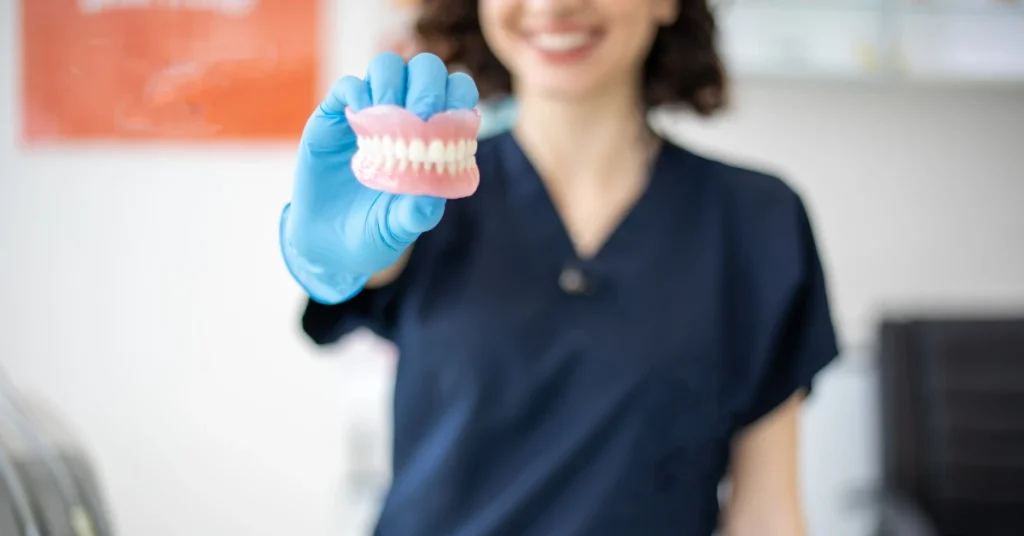
A hybrid denture borrows the look of a denture and the function of a bridge. The teeth and pink base will look familiar. Underneath, a milled metal bar screws down onto your implants and carries the arch clear of your gums.
That bar changes how the whole thing handles a bite. A conventional denture rests on soft tissue and shifts while you chew, which is the reason adhesive exists at all. A hybrid denture routes bite force into bone.
Most labs build it from the same three parts. Glidewell, one of the largest dental labs in the country, lists an acrylic base, denture teeth, and a milled metal framework. Its own name for the finished product is screw-retained hybrid denture.
The design goes back decades. Egilmez and colleagues, writing in the European Journal of Dentistry, trace the metal-acrylic fixed prosthesis to early work on unstable lower dentures.
They also found that these prostheses reduce the impact force of chewing loads. That property is why the design stuck.
Our version is the Hybridge full-arch restoration, which typically uses five implants in the lower arch and six in the upper.
How a Hybrid Denture Differs From an Overdenture
An overdenture comes out at night. A hybrid denture stays in around the clock, and that one difference drives every other item on the list below.
An overdenture snaps onto two to four implants using ball-and-socket or bar-clip attachments. Reviewers at Cleveland Clinic put it plainly. It snaps on, holds until you take it out, and you clean it in your hand.
Those same reviewers settle the naming question, describing a fixed implant denture as one that people sometimes call a hybrid denture. One product, two vocabularies.
| What you’re comparing | Hybrid denture (fixed) | Overdenture (removable) |
|---|---|---|
| Comes out at night | No | Yes |
| Implants per arch | 4 to 6 | 2 to 4 |
| How it holds | Screws to a metal bar | Clips or snaps onto attachments |
| Hardware you replace | None routinely | Clips, roughly every 1 to 2 years |
| Covers the roof of your mouth | No | Often, depending on design |
| Cleaning | Brush and water-pick in place | Take out, clean separately |
| Upfront cost per arch | $20,000 to $30,000 | $3,000 to $6,000 |
Those cost figures come from our side-by-side comparison of fixed implants and implant-supported dentures. An overdenture runs about a fifth of a fixed arch on day one, so plenty of patients start there.
The attachments are where the math shifts. Chaware and Thakkar pooled 16 studies on overdenture attachments for a 2020 meta-analysis in the Journal of Indian Prosthodontics Society. Wear and replacement of the attachments came out as the single dominant maintenance burden.
How often does that happen? One study they cite logged 16 housing replacements in a single year. Loss of retention turned up in 30 percent of the complication cases they pooled, which is the polite way of saying the denture went loose.
Fixed and Removable Arches Carry Separate Billing Codes
If the difference sounds like marketing language, check the billing. A fixed implant arch bills under D6114 for the upper jaw or D6115 for the lower. A removable implant denture bills under D6110 or D6111.
You’ll find all four descriptors in the CDT 2022 code set published by the American Dental Association. A lot of advertising flattens all four into two words, implant dentures.
Ask which code your provider plans to submit. You’ll know exactly which product you’re buying before you sign a thing.
What Screw-Retained Means for Your Cleaning Routine
Screw-retained means your dentist can unscrew the arch in the office for a repair or a deep inspection. Patients hear it and picture a yearly appointment. Those are separate ideas, and mixing them up pushes people toward the wrong choice.
Retrievability is a feature you want. Something eventually needs fixing, and a prosthesis your dentist can take off costs far less to repair than one bonded in for good.
A routine removal cycle is a different animal. Zirconia full-arch restorations need removal one to two times a year for professional cleaning, because zirconia resists polishing in the mouth. Those visits run $500 to $1,500 or more each, according to our breakdown of full-arch lifespans.
An acrylic-and-metal hybrid denture has no routine removal cycle. You brush it, floss around it, and run a water pick along the gum line at home. Close to natural-tooth care (with a little more attention underneath).
A Hybrid Denture Wears Out in Two Stages
Two parts of this arch age on completely different schedules, and almost nobody spells that out at a consult.
The implant posts in your bone can stay stable 20 to 30 years or longer. The acrylic teeth run about 10 to 15 years before replacement. When that day comes, your surgeon builds a new set of teeth onto the framework already sitting in your mouth.
You keep the implants and the bar you paid for. No second surgery.
The metal in that bar does specific work. Chrome cobalt alloy runs approximately twice as strong as commercially pure titanium under flexural load.
That’s a mouthful for a plain idea. The bar bends less under a hard bite, so your screws and the bone below take less abuse.
The acrylic teeth do the opposite. Gen 4 PMMA is a high-density milled acrylic, and it gives a fraction of a millimeter under load. Your natural teeth compress a little too, through the ligament that holds them.
Which Option Fits Your Case
Take two patients with the same failing lower arch. One is 58, still working, and eats out four nights a week. The other is 79, on a fixed income, and mostly wants a denture that quits sliding at lunch.
Over 20 years, the 58-year-old keeps replacing clips and prosthetics, and the running total closes on the price of a fixed arch. Fixed wins on the arithmetic for him.
For the 79-year-old, an overdenture at a fifth of the upfront cost solves the problem she walked in with. Anyone who tells you the expensive option always wins is selling you something.
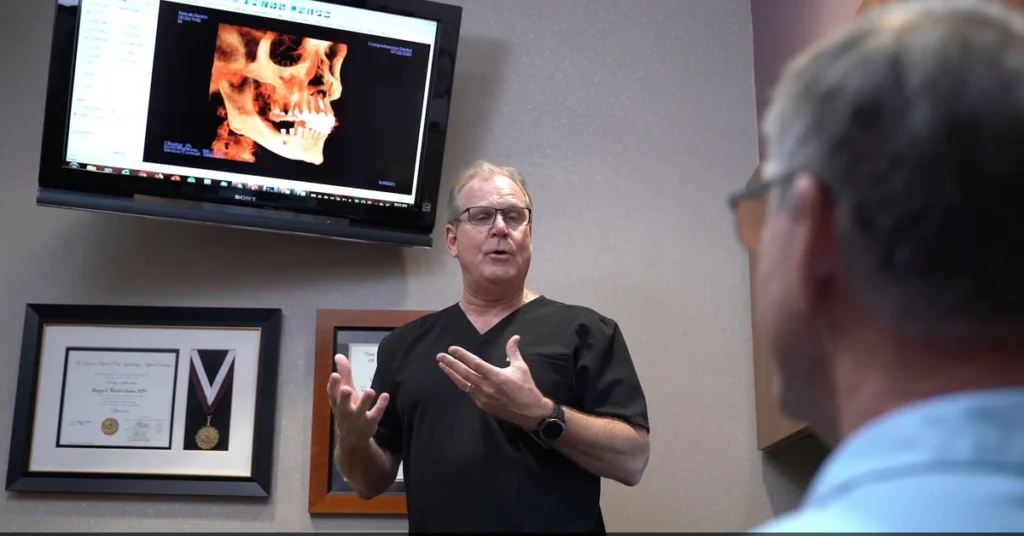
Bone volume and jaw position set the outer limits, and inside those limits your budget and your patience for daily upkeep decide the rest. You’ll sort that out in an hour with a 3D scan.
Answers to Common Questions About Hybrid Dentures
Is a hybrid denture the same as All-on-4?
All-on-4 names an implant count and a placement protocol. Hybrid denture names the prosthesis sitting on top of it. An All-on-4 case usually gets restored with a hybrid denture, so you’ll hear both terms applied to one treatment.
Can I take a hybrid denture out myself?
No, and the screws are the reason. Your dentist can remove it in the office for repairs or inspection. At home it stays put through meals, sleep, and everything else you do in a day.
How many implants does a hybrid denture need?
Four is the working floor across most labs and systems (some protocols call for six). Six shows up often in the upper jaw, where bone runs softer and the bite spreads differently across the arch.
Does a hybrid denture cover the roof of my mouth?
Nothing crosses your palate. The arch follows the ridge where your teeth used to sit. Most patients notice their sense of taste returning within a few weeks.
What happens when the acrylic teeth wear out?
Your surgeon fabricates a new set and attaches them to the framework already in place. You keep the implants and the metal bar from the original case, so you’re paying for teeth instead of a second full-arch rebuild.
If you’re holding quotes from two or three offices right now, bring them in. You’ll get a 3D scan, a tooth-by-tooth read on what’s left, and a written plan naming the exact code we’d submit. The consultation is free, and half our patients came from practices that never took the time to explain any of this.