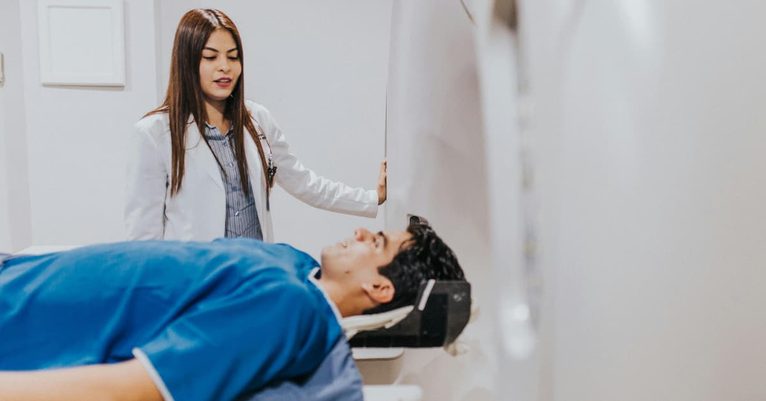
This question usually arrives by phone, and usually the day before the scan. Someone at the radiology desk asked about metal, and now there’s a form to fill in and nobody handy to ask.
Your dental implants are almost never the problem. Titanium and chrome cobalt both stay put in a MRI magnetic field, so nothing in your jaw is going to move.
The real effect is on the picture, and that’s your radiologist’s problem to solve instead of a safety question for you. Your radiologist still makes the final call on your scan. What follows is the physics behind that call, so you can answer the metal question properly.
What the Magnet Does to Titanium and Chrome Cobalt
Most full-arch cases involve two metals. The posts in your bone are titanium screws. The framework above them, in our Hybridge restorations, is a chrome cobalt alloy.
Titanium is paramagnetic (weakly attracted, as opposed to pulled). It responds to a magnetic field far too weakly for that response to have any practical consequence inside a scanner.
Chrome cobalt is the more interesting one, because cobalt on its own is ferromagnetic. So a cobalt alloy ought to behave differently from titanium in a scanner, and it does, though the difference shows up in an unexpected place.
Heinrich and colleagues measured both metals under the ASTM safety standards for a 2021 paper in European Radiology. Titanium deflected 1 degree at 1.5 tesla and 2 degrees at 3 tesla. Chrome cobalt deflected 2 degrees and 6 degrees.
ASTM treats 45 degrees as the point where deflection becomes a hazard. Everything measured came in far under that, and the researchers classified the hardware as safe on that measure.
Fair warning on that study. It tested spinal hardware instead of dental work, and a spinal construct carries far more metal than anything in your mouth. The material comparison still holds.
Heating comes up too. In that same spinal construct, the maximum temperature rise was 0.9 degrees at 1.5 tesla and 1.3 degrees at 3 tesla. For context, the heat-pain threshold for tissue inside your mouth is a rise of 8 to 10 degrees.
Why Image Quality Is the Real Question
Metal in the field distorts the image around it. Radiologists call it a susceptibility artifact, and it shows up as a dark void or a smear near the metal.
RadiologyInfo.org is run jointly by the RSNA and the American College of Radiology. Its reviewers describe dental fillings and braces as usually unaffected by the magnetic field, while still distorting images of the face or brain.
Now the part that runs opposite to expectation. Chrome cobalt distorts images more than titanium does, and that makes the stronger material the messier one on a scan.
Ghadimi and colleagues reviewed dental materials in MRI for Restorative Dentistry and Endodontics in 2018. They place titanium alloy in a category producing limited distortion. Chrome cobalt lands in their non-compatible category, alongside stainless steel orthodontic wire, for producing the strongest distortions.
That trade sits at the center of this topic, and nobody raises it at the consult. Ask about it.
A 3 tesla scanner produces bigger artifacts than a 1.5 tesla machine. The sequence your technologist picks changes the result more than the metal does.
A Knee Scan and a Head Scan Are Different Problems
Having your knee, spine, or shoulder scanned? The metal in your jaw is irrelevant, because artifact from dental work stays local to the mouth and face.
Head and neck imaging is where the conversation changes. Ghadimi’s group note that artifacts from most single-alloy dental restorations leave normal head and neck imaging alone, then name chrome cobalt as the exception.
Nobody should tell you with total confidence how your particular scan will look, us included. What that means practically is your radiologist may adjust the sequence, repeat a series, or accept reduced clarity near your jaw. It’s a technical problem on their side of the glass.
Ask which body part they’re imaging when you book. A shoulder scan and a jaw joint scan sit at opposite ends of this question.
Magnetic Denture Attachments Are a Different Case
All of that assumes your teeth are screwed in. Some implant dentures snap on using magnets instead, and those behave differently in a measured way.
Ghadimi’s review reports deflection angles above 90 degrees for magnetic dental attachments, against that same 45-degree threshold. Published guidance is to remove large prostheses containing cast magnetic alloy before a scan.
Two follow-on points from the same review. The cement holding a prosthesis is generally strong enough to keep it in place (though the fixation gets checked before and after a scan anyway). Magnetic keepers also produce the largest artifacts of any dental component.
So how do you tell which you have? If your teeth come out at night and snap back on, raise that specifically. If only your dentist can remove them, this section passes you by.
What to Tell the MRI Technologist
Volunteer the implants without waiting to be asked. The American College of Radiology screening form asks about pins, rods, screws, and plates, and separately about anything held in place by a magnet. It has no line for osseointegrated dental implants.
Say these four things at check-in
- You have dental implants
- The framework is a chrome cobalt alloy
- The posts are titanium
- Nothing in your mouth is magnetic or removable
One phrase to skip, because it’s a defined regulatory term. Nothing containing metal can be labeled MR Safe. The FDA reserves that label for devices that are nonmagnetic and hold no metal at all.
Metal devices fall under MR Conditional instead, meaning safe under stated conditions. Any dentist who calls your implants MR Safe is using the term loosely.
If the radiology desk can’t identify your hardware from what you tell them, staff default to caution and may reschedule you. That’s the whole argument for walking in with the materials written down instead of remembered.
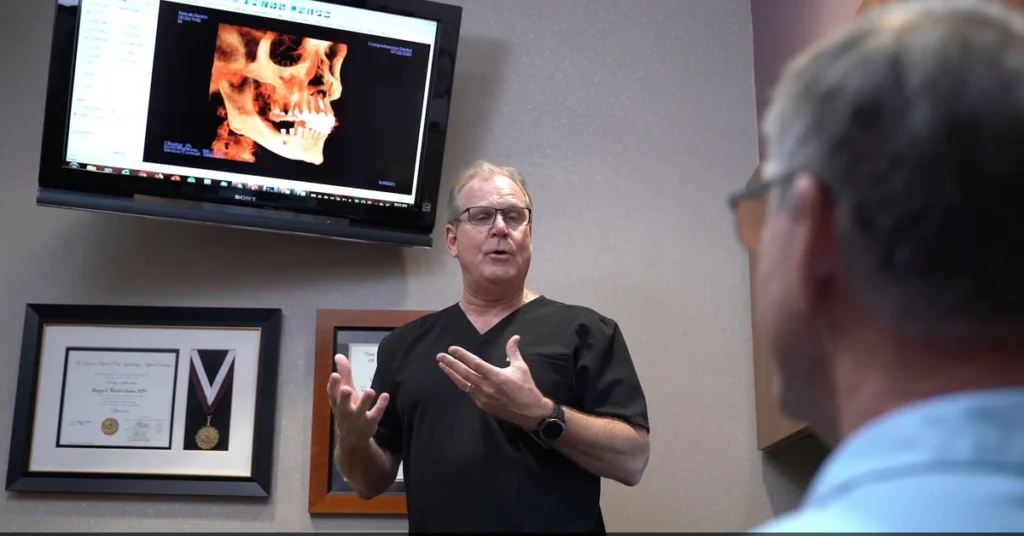
This runs opposite to the CBCT scan we take for planning, where metal creates its own artifact. Different mechanism entirely. CT artifact and MRI artifact share a name and nothing else.
Dental Implants and Airport Metal Detectors
TSA asks travelers to inform an officer about any metal implants. It offers a pat-down as an alternative for anyone who alarms a walk-through detector (or prefers to skip the body scanner).
What TSA’s published guidance never addresses is dental work. The word doesn’t appear anywhere on their medical-implant pages, for implants, crowns, or orthodontics.
So anyone telling you dental implants definitely do or definitely don’t trigger a detector is guessing. We looked for a real source in either direction and found nothing worth citing.
TSA does publish a notification card you can hand an officer instead of explaining out loud. Worth printing to skip that conversation in front of a queue.
The practical answer costs you nothing. Mention it if asked, keep walking if you aren’t, and expect the whole thing to be uneventful.
Answers to Common Questions About MRIs With Dental Implants
Will my dental implants heat up during an MRI?
No published case describes a burn from a dental implant or framework during a scan. Measured temperature rises in metal hardware come in around 1 degree, against a pain threshold of 8 to 10 degrees for oral tissue.
Do I need paperwork from my dentist before an MRI?
Usually not, though it costs nothing to ask your dentist what your framework and posts are made of and write it down. Radiology staff prefer the materials over a brand name they can’t look up.
Can I get a brain MRI with a full-arch restoration?
That’s your radiologist’s decision, and the answer is usually yes with adjustments. Expect reduced clarity in the area closest to your jaw, and expect them to plan around it.
Does a 3 tesla scanner cause more trouble than a 1.5 tesla?
More artifact, yes. Deflection also roughly triples for chrome cobalt between the two, from 2 degrees to 6. Both figures sit far below the 45-degree hazard threshold, so the difference is about picture quality.
Should I mention old crowns and fillings too?
Yes, especially anything containing stainless steel, and especially if the scan covers your head or neck. Older orthodontic wire and steel restorations distort images more than titanium does.
If you’re scheduled for a scan and nobody can tell you what your implants are made of, call and ask. We’ll pull your chart and put the materials in writing for the radiology desk. That takes about five minutes.
Imaging questions before a full-arch decision are a good sign you’re researching properly. The consultation is free.