There is a particular kind of frustration that comes with a dental implant that was never quite right. You went through the procedure. You paid the cost. You did the recovery. And yet something is off – a bite that does not sit correctly, a crown that keeps loosening, a gum line that looks nothing like the photos in the brochure, or an implant that a general dentist is now telling you needs to come out. You trusted someone with that result, and the result let you down.
Working with a dental implant repair specialist is not about assigning blame for what went wrong. It is about getting a second set of eyes with the surgical depth to actually fix it – and fix it in a way that lasts. Not every dentist who places implants is equipped to repair them. But a specialist who works exclusively in implant dentistry handles these cases as a core part of the practice, not an exception.
This guide explains what a dental implant repair specialist actually does, what Dr. Gregg Hendrickson’s diagnostic and correction process looks like, and what patients who have had disappointing implant outcomes can realistically expect from a specialist evaluation in Nevada.
This article is for educational purposes only and does not constitute medical advice. Please consult a qualified implant specialist to evaluate your specific situation.
When You Need More Than the Dentist Who Placed It
Most patients who seek out a dental implant repair specialist were not looking for one. They went back to the original provider first. Some were told their discomfort was normal. Some were told the implant looked fine on the X-ray. Some were offered a replacement crown with no examination of why the first one failed. And some were simply told there was nothing more that could be done.
That last answer is almost never accurate.
The gap between a general implant provider and a dedicated dental implant repair specialist is not just about credentials – it is about volume and focus. A practice that places dozens of implants a week sees failure patterns and complication presentations that a general dentist may encounter once or twice a year. That difference in clinical exposure is what makes the diagnostic process different, and the repair options broader.
Common situations that warrant a specialist evaluation:
- Chronic implant discomfort with no identified cause – Pain around an implant that multiple providers have dismissed or could not explain. In many cases, a 3D cone beam scan reveals bone loss, a micro-fracture, or positional issues that standard X-rays completely miss.
- Recurring abutment screw loosening – An abutment that keeps working loose every few months is not a patient compliance issue. It is a sign of occlusal overload, improper torque on original placement, or an implant angle that creates off-axis forces with every bite.
- Aesthetic outcomes that do not match expectations – Gum recession that exposes the implant collar, a crown that looks nothing like the adjacent teeth, or a gum line that has changed since placement. These are correctable, but require surgical and restorative skill working together.
- Implants placed at corporate dental chains – Large volume practices prioritize throughput. Records are sometimes incomplete, implant systems are not always documented precisely, and patients are left with no clear point of contact when problems develop months or years later.
- Failed full-arch restorations – All-on-4 and full-arch cases that were placed elsewhere and are now causing pain, fracturing prosthetics, or showing bone loss around individual posts are complex repair cases that require a specialist with full-arch surgical experience.
Dr. Hendrickson’s Diagnostic Process for Implant Repair Cases
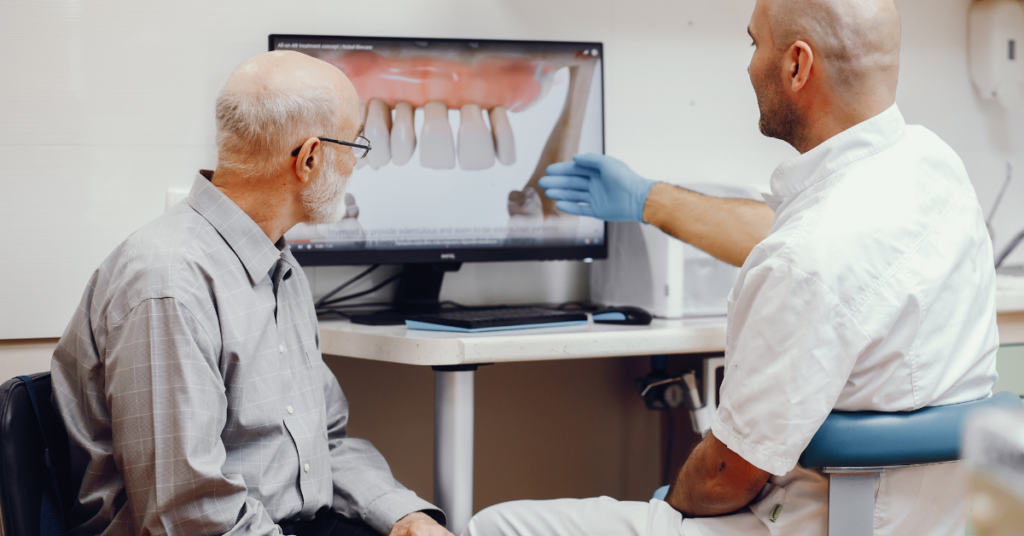
The first appointment with a dental implant repair specialist is an evaluation, not a treatment appointment. The goal is to understand exactly what went wrong before deciding what to do about it. That process looks different here than in a general dental practice.
Step 1 – 3D cone beam CT imaging. A flat X-ray can confirm that an implant post is present. It cannot show bone density around the implant, the integrity of the buccal plate, proximity to adjacent roots, or whether a fracture has occurred within the post. A cone beam CT scan gives a three-dimensional view of the entire site – the bone volume, the implant orientation, the surrounding anatomy, and any signs of peri-implantitis-driven bone loss that would not be visible otherwise. This is the foundation of every implant repair diagnosis at our practice.
Step 2 – Implant system identification. Repairing a broken dental implant requires knowing exactly which system was used – the manufacturer, the platform diameter, the connection type. Without this information, sourcing compatible components is guesswork. Dr. Hendrickson’s team works with a wide range of implant systems and, in most cases, can identify the original hardware from imaging and clinical examination even when the original provider’s records are incomplete or unavailable.
Step 3 – Occlusal analysis. Most implant failures that are attributed to “bad luck” are actually the result of bite forces that were never properly balanced at the time of placement or restoration. An occlusal analysis identifies whether the implant crown is absorbing disproportionate force, whether the patient’s bite pattern creates lateral stress on the implant, and whether a night guard or bite adjustment is needed before any repair will hold long-term.
Step 4 – Soft tissue and bone assessment. The condition of the gum tissue and bone surrounding the implant determines the repair pathway. Early-stage peri-implantitis with shallow pocket depths and minimal bone loss may be treated with debridement and surface decontamination, saving the implant entirely. Advanced bone loss changes the calculus toward removal, grafting, and replacement. Knowing where a case falls on that spectrum is what separates a plan that works from one that fails again in two years.
Step 5 – A direct conversation about options. After the imaging, identification, and clinical findings are complete, you receive a plain-language explanation of what went wrong, what your options are, and what the realistic outcome of each path looks like. No pressure toward the most expensive option. No vague reassurance that everything will be fine. A dental implant repair specialist’s job is to give you the information you need to make a decision you feel confident about. Explore before and after photos from patients who came to us with complicated implant histories to see what that outcome can look like.
What Implant Correction Actually Involves
Once the diagnostic picture is complete, the repair path becomes specific to the case. A dental implant repair specialist does not apply a single solution to every broken or failing implant – the approach depends on what failed, how far the damage has progressed, and what bone and tissue are available to work with.
| Situation | Correction Approach |
|---|---|
| Crown aesthetic failure or fracture | New crown fabricated to match adjacent teeth and correct bite position |
| Recurring abutment loosening | Occlusal correction, proper abutment torque, night guard if bruxism present |
| Gum recession exposing implant collar | Soft tissue grafting to restore coverage and long-term tissue stability |
| Early peri-implantitis | Surgical debridement, implant surface decontamination, guided bone regeneration |
| Fractured implant post | Explantation, site grafting if needed, replacement implant after healing |
| Implant placed at poor angle | Removal, site preparation, guided replacement in correct position |
| Failed full-arch restoration | Prosthetic repair or full revision depending on implant status and bone support |
For cases requiring implant removal and replacement, the sequence follows a predictable clinical path. The failed implant is removed using specialized explantation instruments designed to preserve as much surrounding bone as possible. Where bone volume has been compromised by peri-implantitis or by the original placement, bone grafting is performed at the same appointment to begin rebuilding the site. A replacement implant is placed once the grafted bone has matured – typically 3-6 months later – followed by a final restoration that was planned from the start to achieve the outcome the patient expected the first time.
For patients whose anxiety about returning to a dental chair was intensified by a previous bad experience, IV sedation is available for all surgical repair and replacement procedures. Many patients who came to us after a difficult experience elsewhere have found that sedation changed the entire nature of the appointment.
The Questions a Specialist Asks That Others Do Not
There is a difference in how a dental implant repair specialist approaches a case compared to a generalist seeing a complication. The questions are different because the clinical goal is different – not just fixing the immediate problem, but understanding the system well enough to prevent the same failure from repeating.
At Comprehensive Dental Implant Center, the evaluation for a repair case includes questions that go beyond what broke:
- What was the bone quality and volume at the time of original placement? Thin or low-density bone that was not adequately prepared before the original implant increases failure risk from the start. A repair plan that does not account for bone quality will face the same problem again.
- Was the implant loaded before osseointegration was complete? Premature loading – placing a crown before the implant has fully bonded to the bone – is a known cause of early failure. Understanding the original treatment timeline helps explain what happened and informs how the replacement should be staged.
- Has the patient’s systemic health changed since placement? Conditions like diabetes, medications like bisphosphonates, or significant changes in smoking status can affect how a replacement implant integrates. Managing these factors before placing a new implant improves outcomes measurably.
- What does the patient’s bite pattern look like under load? Occlusal forces that are distributed unevenly across the implant are one of the most common and least-addressed causes of implant component failure. Correcting the bite is often as important as replacing the hardware.
These questions are not meant to assign fault. They are the clinical foundation of a repair plan that works – and stays working.
What to Bring to a Specialist Evaluation
If you are coming in for your dental implant repair specialist evaluation, bringing whatever records you have from the original placement will save time and improve the diagnostic picture. Useful items include:
- Original implant placement records – Including the implant brand, model, diameter, and length if documented. Many patients were never given this information, and that is a solvable problem with imaging, but having it accelerates the process.
- Any X-rays taken at or after placement – Even older images are useful for establishing a timeline of bone level changes around the implant.
- Documentation of the original treatment plan – Particularly for full-arch cases, knowing what the original surgical plan specified versus what was actually placed helps identify where deviations occurred.
- A list of current medications – Particularly any bone-affecting medications such as bisphosphonates (Fosamax, Boniva, Prolia), corticosteroids, or immunosuppressants.
If you have none of this – because the original provider closed, changed ownership, or simply never provided documentation – bring what you can. A cone beam CT and clinical examination can reconstruct most of the diagnostic picture without original records. Patient stories from patients who arrived with incomplete histories from previous providers show how that process typically unfolds.
Start with an Honest Evaluation
A failed or disappointing implant outcome is not something you have to accept as the final result. The question is not whether it can be addressed – in most cases it can – but whether the provider doing the evaluation has the diagnostic tools, the surgical range, and the clinical honesty to tell you what is actually going on and what it will take to correct it.
When patients ask how to find a dental implant repair specialist they can trust, the answer usually comes down to two things: does the practice do this work exclusively, and will they give you a direct answer about what actually went wrong. Dr. Hendrickson sees dental implant repair cases from across Nevada, including patients referred by other dentists and patients who sought a second opinion after being told nothing could be done. The evaluation process is the same regardless of where the original implant was placed or what the previous diagnosis was: imaging first, clinical assessment second, honest conversation about options third.
Both the Paradise and Las Vegas locations schedule dental implant repair evaluations. Book online to set up your consultation. What went wrong does not have to be where the story ends.
Dental Implant Repair FAQs
What does a dental implant repair specialist do?
A dental implant repair specialist diagnoses and corrects failed or poorly placed implants using advanced tools like 3D cone beam CT imaging, occlusal analysis, and surgical techniques. Unlike general dentists, specialists handle complex implant complications daily, giving them the clinical depth to identify problems others miss and offer a broader range of repair options.
How do I know if my implant needs to be seen by a specialist?
Consider a specialist evaluation if you have chronic pain around your implant with no clear diagnosis, a crown or abutment that keeps loosening, gum recession exposing the implant collar, or an implant placed at a corporate dental chain with incomplete records. If you’ve been told nothing can be done, a specialist opinion is almost always worth seeking.
Can a failing implant be saved, or does it always need to be removed?
Not all failing implants need to be removed. Early-stage peri-implantitis with minimal bone loss can often be treated with debridement and surface decontamination, preserving the implant entirely. Removal is typically necessary only when bone loss is advanced, the implant post is fractured, or the implant was placed at an angle that cannot be corrected restoratively.
What happens during a dental implant repair evaluation?
The evaluation includes a 3D cone beam CT scan to assess bone volume and implant integrity, identification of the original implant system, an occlusal (bite) analysis, and a soft tissue and bone assessment. After reviewing all findings, you’ll receive a plain-language explanation of what went wrong, your repair options, and realistic expectations for each—with no pressure toward any particular treatment.
Why does my abutment screw keep coming loose?
A repeatedly loosening abutment is rarely a patient compliance issue. It typically indicates occlusal overload (too much bite force on the implant), improper torque applied during original placement, or an implant angle that generates off-axis forces with every bite. Correcting the bite, re-torquing to spec, and in some cases fabricating a night guard are the usual steps to resolve recurring loosening.
Can implant aesthetics be corrected after placement?
Yes. Gum recession exposing the implant collar, a crown that doesn’t match adjacent teeth, and changes to the gum line since placement are all correctable. Depending on the issue, solutions may include soft tissue grafting to restore gum coverage, a new crown fabricated for better color and shape match, or a combination of surgical and restorative work to achieve the result that was expected originally.
What should I bring to my first implant repair consultation?
Bring any records from your original placement—implant brand, model, and dimensions if documented—along with any X-rays taken at or after placement, your original treatment plan if available, and a current medication list (especially bone-affecting drugs like bisphosphonates). If you have no records because the original provider closed or never shared documentation, a cone beam CT and clinical exam can reconstruct most of the diagnostic picture.
Is sedation available for implant repair procedures?
Yes. IV sedation is available for all surgical repair and replacement procedures. This is particularly relevant for patients whose anxiety about returning to the dental chair was worsened by a previous difficult experience. Many patients report that sedation significantly changed their experience compared to prior procedures done elsewhere.