Medical Disclaimer: This content is for educational purposes only and does not constitute medical advice, diagnosis, or treatment. Always consult with a qualified dental professional regarding your specific implant concerns.
Up to 25% of patients with full arch restorations develop peri-implantitis within the first 10 years, according to a review in Frontiers of Oral and Maxillofacial Medicine. When pain, looseness, or something that looks off first appears, the fear is real – but so are the options. Failing full-arch implants solutions exist at every stage, and acting early often means saving the architecture you already have.
At NV Implant Center in Las Vegas and Henderson, Nevada, Dr. Gregg Hendrickson works with patients who arrive after years of deterioration or treatment elsewhere that didn’t hold. This article covers what to look for, when to act, and what a trained implant specialist can do.
1. Warning Signs of Failing Full-Arch Implants
The challenge with failing full arch implants is timing. Warning signs often develop slowly – sometimes silently. By the time a patient notices something significant, the underlying problem may already be advanced. Knowing what to look for is the foundation of any failing full arch implants solutions plan.
Peri-implantitis begins as inflammation in the soft tissue and progresses to bone loss around the implant posts. The critical window for effective treatment is before significant bone volume is lost.
Here are the clinical warning signs that call for immediate evaluation:
- Bleeding when you brush or rinse – consistent bleeding around the gum line signals early peri-implant mucositis, the direct precursor to bone destruction
- Gum recession exposing the implant collar – when the pink tissue pulls back and metal becomes visible, bone support has already shifted
- Persistent pain or pressure during chewing – discomfort is not normal in a stable restoration; pain indicates instability, infection, or both
- Mobility or clicking sounds in the prosthesis – any movement signals the implant-to-bone connection has been compromised
- Foul taste or persistent bad breath – bacteria colonizing around failing implants produce sulfur compounds; this tracks with active peri-implantitis
- Swelling or visible pus at the gum line – requires same-week evaluation; signals active infection that accelerates bone loss rapidly
- Loosened or fractured prosthetic components – a shifting bridge, cracked prosthesis, or loose screw points to mechanical failure or implant instability
One critical note: some patients experience no pain at all as peri-implantitis advances. Bone loss can be entirely silent until a tipping point is reached. Annual exams with radiographs are not optional – they are the only reliable way to catch failing full arch implants while treatment options remain strongest.
⚠️ Call NV Implant Center Immediately If You Notice:
- Any mobility or rocking in your prosthesis
- Swelling, pus, or bleeding that won’t stop
- Visible metal exposure at the gum line
- Sudden change in your bite or jaw position
- Persistent pain more than 6 weeks post-surgery
2. What Causes Full Arch Implant Failure
Understanding why failing full arch implants solutions become necessary is as important as recognizing the warning signs. Failure accumulates through biological, mechanical, and behavioral factors – often in combination.
Research from the University of Pennsylvania in PMC identifies core risk indicators: plaque accumulation, smoking, periodontitis history, and poorly controlled systemic conditions. Patients who skipped regular care showed a 26.1% peri-implantitis rate (Clinical Oral Investigations, 2024).
The most common contributing factors in full arch implant failure include:
- Smoking and tobacco use – restricts blood supply to the peri-implant tissue, slows healing significantly, and raises infection risk at every implant post
- Uncontrolled diabetes or systemic disease – compromised immune response and delayed healing create conditions where peri-implant bacteria advance unchecked
- Poor oral hygiene around the prosthesis – full arch restorations require specific daily cleaning; water flossers, interdental brushes, and twice-yearly professional cleanings are non-negotiable
- Bruxism (teeth grinding or clenching) – excessive force overloads the implants mechanically, accelerating bone loss and fracturing prosthetic components
- Insufficient bone volume at original placement – implants placed without adequate grafting may fail to fully osseointegrate, or may lose integration under load over time
- History of periodontitis – patients who lost teeth to gum disease face elevated biological risk; the same bacterial species responsible for original tooth loss can target implants directly
- Skipped maintenance appointments – this single modifiable factor separates 5% and 26% peri-implantitis outcomes; regular professional care is the clearest dividing line in long-term implant health
Mechanical failures compound biological ones. A misfitting prosthesis creates chronic microstress at the implant-bone interface, contributing to progressive bone loss even in patients with good hygiene habits.
| Risk Factor | Effect on Full Arch Implants | Modifiable? |
|---|---|---|
| Active smoking | Restricts blood flow, raises infection risk | Yes – cessation improves outcomes |
| Uncontrolled diabetes | Impairs healing and immune defense | Yes – glycemic control is critical |
| Bruxism | Mechanical overload cracks components and bone | Yes – nightguards and monitoring |
| Periodontitis history | Elevated biological risk at all implant sites | Managed, not eliminated |
| Skipped maintenance | Single biggest preventable driver of peri-implantitis | Yes – fully preventable |
3. Urgent Steps When You Suspect Failing Full Arch Implants
If something feels wrong with your full arch restoration right now, these steps matter immediately. The principle: failing full arch implants solutions become more limited the longer you wait. Bone loss is progressive and irreversible. What targeted debridement can resolve today may require full arch bone reconstruction in six months.
- Contact an implant specialist within days, not weeks – general dentists may lack the surgical training or imaging technology to accurately assess full arch implant failure; seek a provider with specific implant expertise
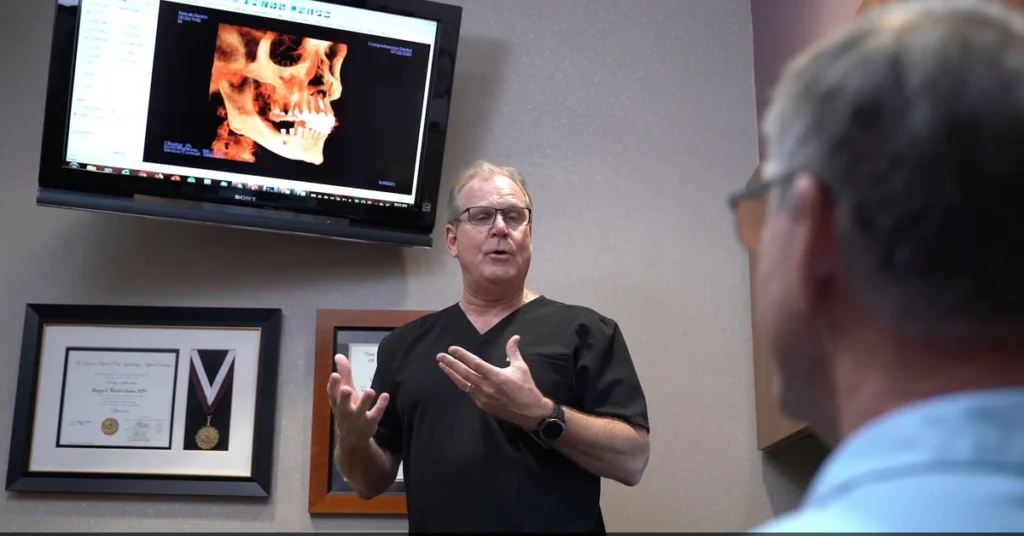
- Request a CBCT 3D scan at your evaluation – two-dimensional X-rays miss volumetric bone loss; cone-beam computed tomography is the diagnostic standard for evaluating failing full arch implants and planning intervention, as detailed by Decisions in Dentistry
- Do not self-treat with OTC products – antiseptic rinses and antibiotics manage symptoms but do not address underlying bone loss; they may mask the signals that indicate worsening disease
- Document your symptoms and timeline – when did it start? Bite changes? Intermittent or constant swelling? This history helps determine whether the problem is biological, mechanical, or both
- Bring original treatment records if available – surgical reports, prosthetic records, and prior radiographs give critical context – especially if you were treated by a different provider
Any provider evaluating a failing full arch case must complete clinical tissue exams at each implant site, probing measurements, and a CBCT scan. Diagnosis without 3D imaging means working from an incomplete picture.
4. How Dr. Hendrickson Salvages Failing Full Arch Implants
Not every failing full arch implants solutions case ends in complete replacement. When a patient arrives at NV Implant Center with early to moderate implant failure, the first goal is determining what can be preserved.
Dr. Hendrickson begins with CBCT imaging to map bone volume, density, and each implant’s three-dimensional position relative to remaining bone. That data drives the salvage strategy – no two cases are identical.
Depending on clinical findings, the salvage approaches used at NV Implant Center may include:
- Non-surgical peri-implantitis debridement – mechanical cleaning of the implant surface combined with antiseptic protocols; best suited for early-stage disease where bone loss is minimal and the implant surface can be fully accessed
- Surgical peri-implant therapy with bone recontouring – for moderate bone loss, a surgical approach provides direct access to the defect, thorough surface decontamination, and reshaping of the bone architecture to reduce the depth of infected pockets
- Guided bone regeneration (GBR) – when bone defects are contained rather than circumferential, grafting with a barrier membrane can rebuild lost support around a stable implant; PMC research documents successful implant salvage using GBR in appropriately selected cases
- Prosthetic component replacement – when biological implants remain stable but the prosthesis is fractured, ill-fitting, or worn, replacing the bridge or bar resolves mechanical failure without surgical intervention
- Occlusal adjustment and nightguard fabrication – when bruxism is a contributing factor, addressing the force overload directly is part of the treatment plan; repairing tissue without correcting mechanical stress means working against the same destructive force that caused the problem
Aesthetic outcomes from salvage depend on how much soft tissue and bone architecture remains. When tissue is intact and bone levels are adequate, salvage restores health with no visible change to the smile. Early intervention – before recession and ridge collapse – protects both function and appearance simultaneously.
Learn more about the implant restoration options available at NV Implant Center.
5. When Salvage Isn’t Enough – Full Arch Replacement
Some patients arrive at NV Implant Center after too much time has passed – or after repair attempts that never addressed the underlying biology. When implants have fully lost osseointegration, salvage is no longer viable. Full arch replacement becomes the path forward for these failing full arch implants solutions.
Full arch replacement after failure is more involved than the original procedure, but it is achievable. Long-term case data confirms that failed implants can be removed, bone volume rebuilt, and new implants placed with strong outcomes (PMC long-term study).
The replacement process at NV Implant Center follows a structured protocol:
- Complete CBCT assessment of all remaining bone volume, tissue quality, and adjacent anatomical structures before any surgical planning begins
- Atraumatic removal of failed implants – techniques specifically designed to preserve surrounding bone during extraction; protecting the foundation for what comes next is a priority from the first incision
- Bone grafting where indicated – sites that lost volume through infection or resorption are rebuilt before or simultaneously with new implant placement; the dual-zone technique addresses buccal plate and crestal bone in a single procedure
- Restoratively driven implant positioning – new implants are placed where the final prosthesis requires them aesthetically and functionally, not simply where bone is most convenient
- Provisional restoration from day one – patients leave with a functional prosthesis; appearance and chewing ability are maintained throughout osseointegration
Maintaining aesthetics through replacement is built into the plan from day one. Ridge contour preservation, deliberate gum tissue management, and digital smile design ensure the definitive restoration looks exactly as intended. Explore our full mouth dental implant process to understand each stage.
Frequently Asked Questions About Failing Full Arch Implants Solutions
How do I know if my failing full arch implants need urgent care?
Any mobility in the prosthesis, visible pus, acute swelling, or sudden bite changes require same-week evaluation. For subtler symptoms – bleeding when brushing, mild persistent discomfort, foul taste – schedule within two weeks. Failing full arch implants solutions are most effective before significant bone loss has occurred.
Can failing full arch implants be saved without starting over?
Often, yes. Early to moderate peri-implantitis with contained bone defects and stable osseointegration can be addressed through surgical debridement, guided bone regeneration, or prosthetic correction. CBCT imaging tells Dr. Hendrickson definitively whether salvage is realistic for your specific situation.
What happens if I ignore a failing full arch implant?
Peri-implantitis is progressive. Bone loss continues, gum tissue recedes, and the implants eventually lose the support needed for a fixed prosthesis. What can be resolved surgically today may require complete removal and bone reconstruction if delayed by even a few months.
How long does full arch implant replacement take when salvage isn’t possible?
The timeline varies by grafting needs and healing time. Many patients receive a provisional restoration the same day as surgery, staying functional throughout. Dr. Hendrickson provides a personalized timeline at your consultation. Contact us to schedule a free implant consultation at our Las Vegas or Henderson office.
Does insurance help cover failing full arch implants solutions?
Coverage varies by plan. Some surgical interventions qualify under major restorative or oral surgery benefits. NV Implant Center reviews your insurance and walks you through financing options before any treatment begins.
How do I protect my current full arch restoration from failing?
Consistent professional maintenance – twice yearly minimum with an implant-trained provider – is the single most protective factor. Add daily water flosser use, smoking cessation, management of conditions like diabetes, and a nightguard if you grind. These habits separate patients who keep restorations for decades from those who eventually need failing full arch implants solutions.
Ready to Address Your Failing Full Arch Implants Today
A failing full arch restoration does not mean your second chance at a permanent smile is over. It means the situation needs a specialist who can assess the complete picture – bone, tissue, bite, and aesthetics – and build a plan around what is actually there.
Dr. Gregg Hendrickson has helped patients across Las Vegas, Henderson, Summerlin, and Southern Nevada who arrived uncertain about their implants. The sooner you have an accurate diagnosis, the more failing full arch implants solutions remain available.
Contact NV Implant Center to schedule your consultation at our Las Vegas or Henderson office, or request your appointment online.