After two decades of placing full-arch implants, I still remember the question that stops most patients considering full-arch implants in their tracks: “How can just four implants hold up twelve teeth?” It’s a reasonable concern. The engineering seems counterintuitive – until you understand how these systems actually work.
FFull-arch implants are fixed prosthetic restorations that replace an entire upper or lower arch of teeth using strategically placed titanium dental implants to support a complete set of prosthetic teeth. Unlike traditional dentures that rest on the gums or individual implants placed for each missing tooth, full-arch implants use four to six implants to restore function, stability, and aesthetics across the entire arch.
Unlike traditional dentures that rest on your gums, or individual implants for each missing tooth, full-arch solutions use between four and six precisely positioned implants to support a complete set of teeth. The three main approaches – All-on-4, All-on-6, and Hybridge – differ in implant number, placement strategy, and customization level, but all share the same goal: giving you back a fully functional, permanently fixed set of teeth.
The technology behind these systems represents a shift in how we think about tooth replacement. Rather than trying to replicate what you lost implant-by-implant, we’re building a new foundation engineered to distribute forces efficiently and integrate with your existing bone. The results speak for themselves – success rates consistently above 95%, with many patients keeping their full-arch restorations functional for decades.
Let me walk you through how each system works, the biomechanics that make them stable, and how we determine which approach fits your specific situation.
How Full-Arch Implants Work: The Foundation Principle Behind Full-Arch Implant Stability
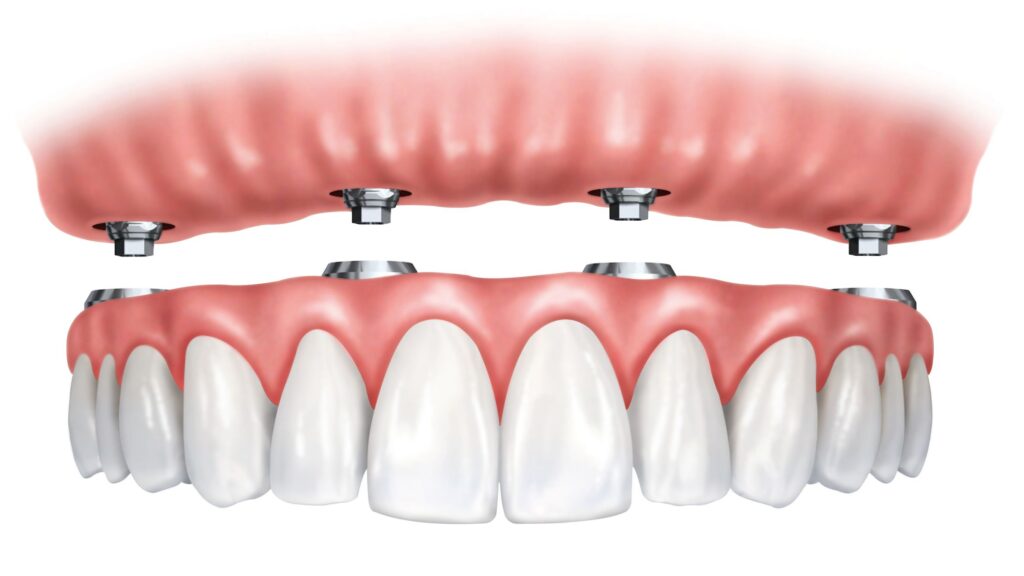
The reason you don’t need an implant for every tooth comes down to physics and biology working together. Think of full-arch implants like the foundation of a bridge – you don’t need support columns every few feet if you engineer the structure correctly. This foundation-based design is what allows full-arch implants to support twelve or more teeth while maintaining long-term stability and comfort.
Here’s what makes it work: each implant integrates with your jawbone through osseointegration, becoming a solid anchor point. When we position multiple implants with proper spacing and angulation, they create a platform that distributes chewing forces across the entire arch. The prosthetic teeth attached to this platform function as a unit, with no single implant carrying excessive load.
The key is in the placement strategy. Front implants positioned in the denser bone of your anterior jaw handle primarily vertical forces from biting. Posterior implants – often angled to maximize bone contact – manage the heavier grinding forces from chewing. This distribution means each implant does the work of supporting multiple teeth without being overloaded.
All full-arch systems share these core principles, and regardless of the specific system used, full-arch implants rely on the same biomechanical principles to remain secure and functional over time:
- Immediate stability – Implants are placed in areas of dense bone that can handle immediate loading. Most patients receive temporary teeth the same day as surgery.
- Force distribution – Strategic spacing creates a stable polygon of support that handles chewing forces efficiently across the entire arch.
- Bone preservation – Unlike dentures that allow bone loss, implants stimulate bone through function, maintaining jaw structure long-term.
- Fixed attachment – The prosthesis screws directly to the implant abutments. It doesn’t move, click, or require adhesives like traditional dentures.
- Access for maintenance – While fixed in your mouth, the prosthesis can be removed by your dentist for professional cleaning and any needed repairs.
Within these shared principles, the three main full-arch approaches – All-on-4, All-on-6, and Hybridge – take different strategic paths to achieve stability and longevity.
All-on-4: The Proven Pioneer
Developed in the 1990s by Dr. Paulo Maló, the All-on-4 concept is one of the most widely used full-arch implant solutions, proving that four strategically placed implants can reliably support a complete dental arch.
The Placement Strategy
All-on-4 uses exactly four implants per arch: two straight implants in the anterior (front) region and two angled 30-45 degrees in the posterior (back). This angulation avoids anatomical limitations – sinus cavities in the upper jaw, nerve canals in the lower jaw – eliminating the need for bone grafting in most cases.
The angled implants also increase the anterior-posterior spread of the implant platform, creating a larger polygon of support. This wider platform distributes forces better and reduces stress on individual implants.
Studies tracking All-on-4 show prosthetic survival rates of 98.8% in the lower jaw and 95-97% in the upper jaw over 10 years. Individual implant survival sits at 94.8% after a decade.
Best Candidates for All-on-4
- Adequate bone density – Enough healthy bone in anterior and posterior regions to support four implants. Moderate bone loss is usually workable.
- Cost considerations – Fewer implants typically mean lower initial costs compared to systems using more implants.
- Faster treatment – Streamlined approach often allows same-day temporary teeth with final restoration in 3-4 months.
- Good overall health – Conditions like uncontrolled diabetes or heavy smoking may indicate a more robust system is safer.
The main limitation: if one implant fails, the entire restoration becomes compromised until replaced.
All-on-6: Enhanced Stability Through Redundancy
All-on-6 full-arch implants expand on the All-on-4 approach by adding two additional implants to improve stability, load distribution, and long-term reliability.
The Six-Implant Configuration
With six implants available, placement involves more evenly distributed patterns with less extreme angulation. The additional implants allow straighter positioning because you’re not relying solely on angled posterior implants. This increases the surface area integrated with bone, spreading forces across more anchor points.
The redundancy means if one implant develops problems, five others continue supporting the restoration – the prosthesis remains stable while we address the issue.
Research shows All-on-6 achieves 98-99% success rates. A 2022 study found 99.0% implant survival for All-on-6 compared to 89.7% for All-on-4 in the same population.
When All-on-6 Makes Sense
- Heavy chewers and bruxism – Grinding or clenching distributes forces across six implants, reducing wear on each.
- Better bone volume – Adequate bone to accommodate six implants, typically requiring more than All-on-4.
- Insurance against failure – Redundancy means single implant complications don’t immediately compromise the restoration.
- Upper jaw restoration – The maxilla has softer bone. Six implants provide extra stability.
- Long-term investment – Higher initial cost but enhanced stability may reduce maintenance needs over decades.
The trade-off: more implants mean more surgical sites, potentially longer surgery, and higher initial cost.
Hybridge: The Customizable System
Hybridge isn’t just a specific implant count – it’s a complete treatment system with proprietary planning protocols, surgical guides, and prosthetic components designed to work together. The approach emphasizes customization based on your individual bone quality, bite forces, and long-term goals.
From a clinical perspective, Hybridge full-arch implants are designed for patients who benefit from a customized implant count and precision-guided placement rather than a standardized full-arch implant configuration.
The Hybridge Approach
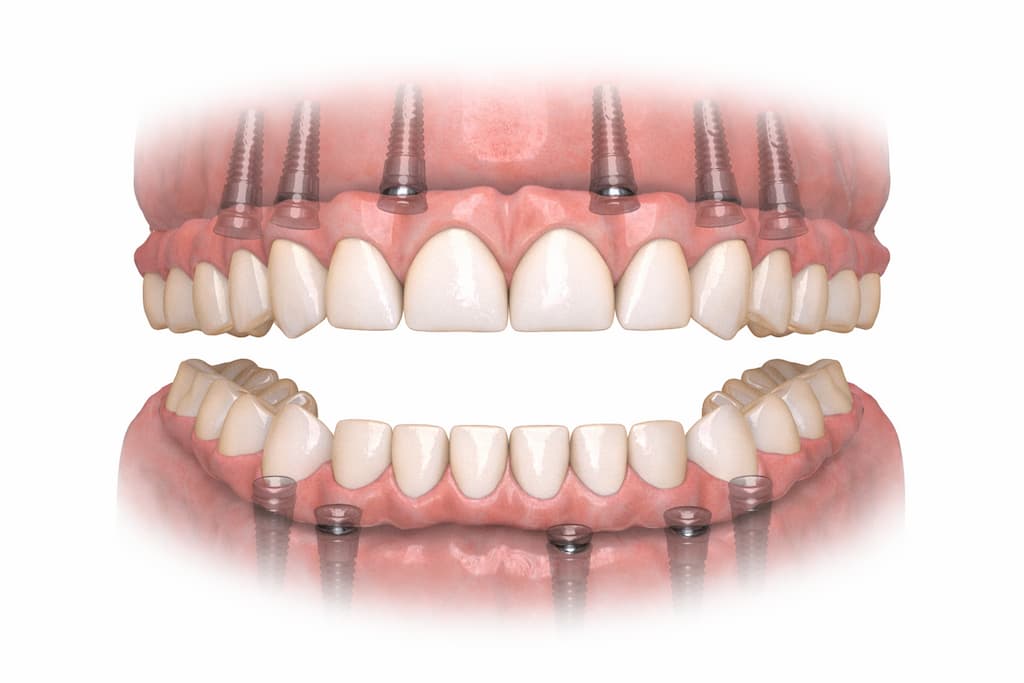
Most Hybridge cases use five to six implants per arch, positioned using computer-guided surgical planning specific to the system. The planning process analyzes bone density throughout your jaw and determines optimal implant positions for your anatomy. Rather than following a standardized four-implant or six-implant template, placement is customized to your bone structure.
The prosthetic restoration in Hybridge uses a chrome-cobalt metal framework with cross-linked PMMA (a durable acrylic). This specific combination of materials provides strength while keeping the restoration serviceable – your dentist can remove it if needed for professional cleaning or repairs, but you cannot remove it yourself.
Cost Structure Philosophy
Hybridge pricing is typically based on the complete treatment package rather than charging per implant. This means whether your case requires five or six implants, the treatment cost remains consistent. The system positions this as “insurance” for your teeth – using the number of implants your case actually needs for long-term stability rather than minimizing implant count to reduce costs.
Key Hybridge Advantages
- Customized planning – Computer analysis determines ideal implant number and position for your specific bone quality and bite pattern.
- Proprietary surgical guides – Precision guides manufactured for your case ensure implants place exactly as planned.
- Simplified treatment approach – The complete system typically allows faster treatment compared to traditional implant bridgework.
- Definitive solution focus – Particularly beneficial for patients tired of ongoing dental problems from chronic decay or periodontal disease. This provides an end-point.
- Serviceable by dentist – Unlike permanently cemented restorations, Hybridge can be removed for thorough professional cleaning and maintenance.
Ideal Hybridge Candidates
Hybridge works particularly well for patients who want a comprehensive, customized approach and are less focused on choosing the absolute minimum number of implants. If you’ve dealt with years of dental problems and want a definitive solution tailored specifically to your situation, the Hybridge system’s planning process addresses that need.
The system also appeals to patients who value the ability to have their restoration professionally serviced without permanent cement or permanent attachment that can’t be accessed for cleaning.
Structural Planning: The Science Behind Successful Full-Arch Implants

Success starts with precise planning. We’re engineering a foundation that will handle hundreds of pounds of biting force, thousands of chewing cycles daily, for decades.
CT Scan Analysis and Computer-Guided Surgery
Planning begins with a cone beam CT scan providing three-dimensional imaging of your jaw. This shows bone density throughout your arch, nerve and sinus locations, and exact bone dimensions. We measure bone quality in Hounsfield units – a rating of density and strength at any location.
Modern planning software lets us virtually place implants before surgery, test configurations, and adjust angles. Once finalized, surgical guides are manufactured that fit precisely over your gums and guide drill placement to within fractions of a millimeter. This precision allows implants to place exactly where planned – critical for proper force distribution.
Critical Planning Factors
- Anterior-posterior spread – Distance between front and back implants determines leverage and cantilever length. Wider spread means better stability.
- Implant angulation – Angled implants increase bone contact length and avoid anatomical structures but create different force vectors.
- Bone quality distribution – We place implants where bone is strongest, even if adjusting standard positions. Bone dictates placement.
- Prosthetic tooth position – Final teeth must look natural and allow proper lip support while maintaining structural integrity.
- Occlusion planning – How upper and lower teeth contact affects force direction. We plan implant placement with final bite in mind.
This planning phase typically takes several hours of analysis – time invested in ensuring your restoration has the foundation for long-term success.
Biomechanics: How Four to Six Implants Support Twelve Teeth
The engineering balances using as few implants as possible while ensuring no implant is overloaded.
Force Distribution and Cantilevers
When you bite down, force is distributed across all implants through the rigid prosthetic framework. Average biting forces range from 150-200 pounds in front teeth to 300-500 pounds in molars. When distributed across four to six implants, each carries a manageable portion.
The back teeth typically extend slightly beyond the most posterior implant – a cantilever that creates leverage, multiplying forces. Proper implant spread matters because excessive cantilever creates stress. Angling posterior implants backward increases the spread and reduces the cantilever length. Six-implant systems can place additional implants further back, minimizing the cantilever.
Bone Quality and Angulation
The mandible (lower jaw) has dense cortical bone providing excellent stability. The maxilla (upper jaw) has softer bone throughout – why upper cases sometimes benefit from additional implants.
Angled implants increase the length embedded in bone. A 45-degree angled implant achieves more bone contact than a shorter vertical implant in the same location. More contact means better load distribution. The trade-off is that angled implants create different force vectors the prosthetic framework must accommodate.
Long-Term Success: What to Expect Over Decades

Full-arch implants are designed to last the rest of your life, but longevity depends on factors within your control and planning from the start. Long-term studies consistently show that properly planned and maintained full-arch implants outperform removable dentures in stability, bone preservation, and patient satisfaction.
Maintenance and Success Factors
Daily care resembles brushing natural teeth with extra attention where the prosthesis meets your gums. Water flossers work well for flushing debris. Professional cleanings every 3-4 months prevent peri-implantitis, which progresses faster than periodontitis. We check for loosening components, examine tissue health, and take periodic X-rays to monitor bone levels.
- Smoking cessation – Remains the biggest modifiable risk factor. Quitting dramatically improves outcomes.
- Diabetes control – Well-controlled diabetes (HbA1c below 7%) doesn’t significantly increase complications.
- Adequate initial bone – Implants placed in good quality bone with proper primary stability have better long-term integration.
- Proper occlusion – Balanced bite forces prevent excessive stress on individual implants.
- Patient compliance – Attending scheduled maintenance matters enormously for preventing complications.
If you have significant risk factors – heavy bruxism, periodontitis history, compromised bone, or medical conditions – systems using more implants provide a safety margin. Ten-year data shows All-on-6 achieves slightly better outcomes than All-on-4, particularly in the upper jaw and in patients with risk factors.
Choosing Your Full-Arch Solution
All-on-4, All-on-6, and Hybridge full-arch implants each offer proven, long-term solutions for replacing an entire arch of missing or failing teeth. The right choice depends on your bone quality, bite forces, risk factors, budget, and long-term goals. What matters most is that your treatment is planned specifically for your anatomy and executed precisely.
During your consultation, we’ll complete a thorough evaluation including CT imaging, assess your bone quality and volume, discuss your medical history and lifestyle factors, and show you which approach best fits your situation. The goal isn’t to fit you into a predetermined system – it’s to engineer a solution that will function reliably for decades.
Choosing the right full-arch implants depends on bone quality, bite forces, health history, and long-term expectations—not a one-size-fits-all approach. If you’re ready to explore how full-arch implants can restore your ability to eat, speak, and smile with confidence, contact Comprehensive Dental Implant Center to schedule your consultation. We’ll answer your questions, show you your options, and create a treatment plan built around your specific needs.
Full-Arch Implants FAQs: All-on-4, All-on-6, and Hybridge Explained
What are full-arch implants?
Full-arch implants are fixed dental restorations that replace all teeth in the upper or lower jaw using four to six strategically placed dental implants that support a full prosthetic arch.
How can four to six implants support a full set of teeth?
Full-arch implants rely on precise implant placement, angulation, and force distribution. When implants integrate with the jawbone, they create a stable foundation that supports a full arch of teeth as a single unit.
What is the difference between All-on-4 and All-on-6 full-arch implants?
All-on-4 uses four implants to support the arch, while All-on-6 uses six implants for additional stability and redundancy. All-on-6 is often recommended for patients with stronger bite forces or softer bone.
What makes Hybridge full-arch implants different?
Hybridge full-arch implants use customized digital planning, proprietary surgical guides, and a serviceable prosthetic design. Implant placement is tailored to each patient’s bone quality rather than a fixed implant count.
How long do full-arch implants last?
With proper planning, oral hygiene, and professional maintenance, full-arch implants can remain functional for decades. Long-term studies show success rates exceeding 95%.
Are full-arch implants better than dentures?
Unlike dentures, full-arch implants are fixed in place, do not rely on adhesives, preserve jawbone structure, and allow patients to eat and speak with greater comfort and confidence.